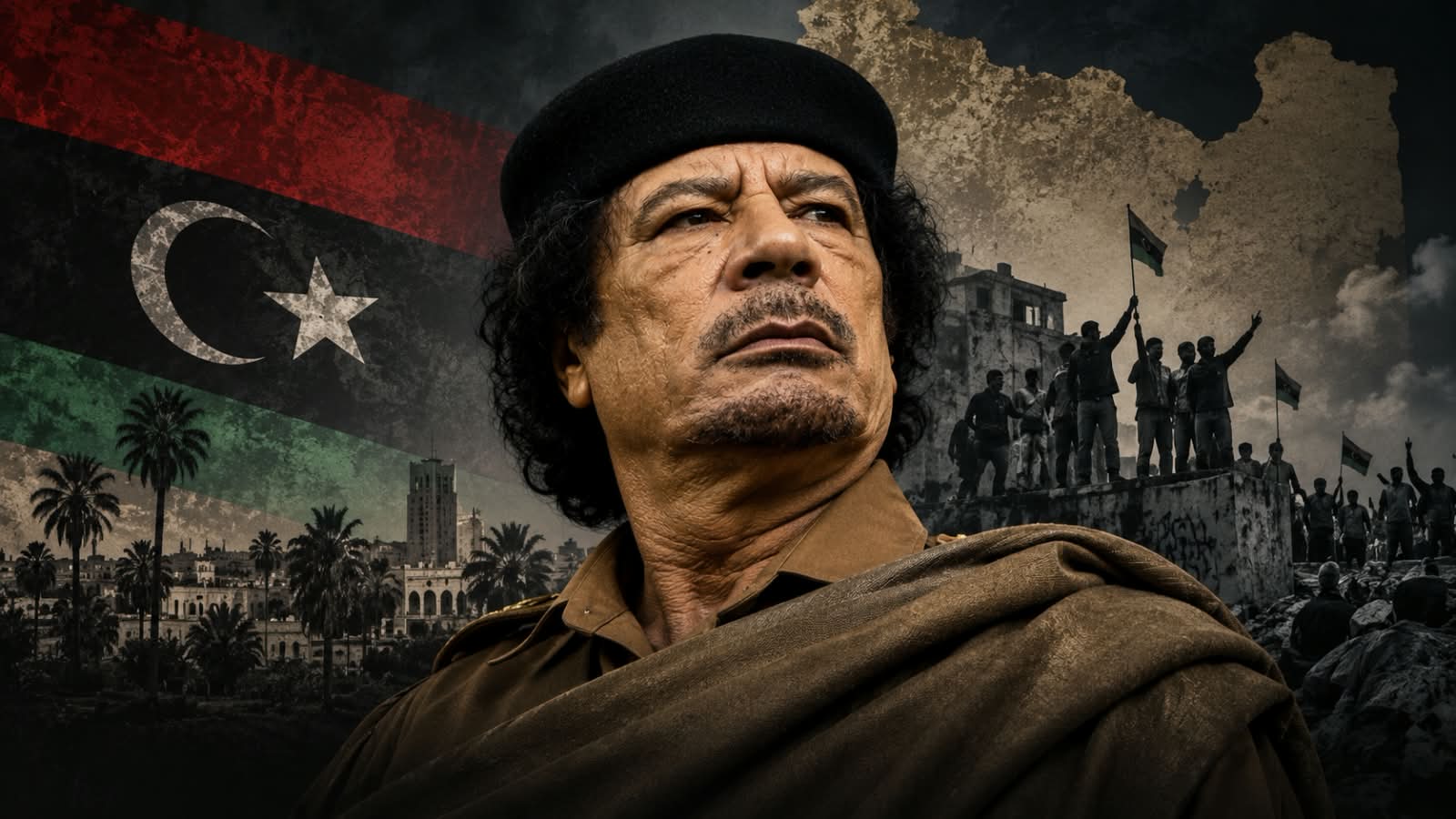
Muammar Mohammed Abu Minyar al-Gaddafi was one of the most controversial and influential political figures in modern Libyan history. He came to power in 1969 at the age of just 27 after leading a military coup that ended Libya’s monarchy. For more than four decades, he remained at the center of the country’s political system.
Gaddafi’s rule combined revolutionary nationalism, socialism, state control, oil wealth and tight political authority. He rejected many of the political institutions associated with Western democracy and attempted to create an alternative system based on his own political philosophy.
At the same time, his rule was marked by accusations of political repression, the suppression of dissent, and the concentration of power around himself and his inner circle. His long reign finally came to an end during the Libyan uprising and civil war of 2011.
The story of Gaddafi is therefore more than the rise and fall of a single ruler. It is also a story about nationalism, oil wealth, revolutionary politics, authoritarian power and international intervention.
Early Life, Education and Political Influences
Muammar Gaddafi was born on June 7, 1942, in the Sirte region of Libya into a Bedouin family. He received religious education during his childhood and later attended a preparatory school in Sabha, in the Fezzan region, from 1956 to 1961.
During his school years, Gaddafi developed a strong interest in politics and Arab nationalism. He was particularly influenced by Egyptian President Gamal Abdel Nasser, whose ideas about Arab unity, independence and resistance to foreign influence had a major impact on the young Gaddafi.
His involvement in political activities eventually led to his expulsion from Sabha in 1961. He later studied at the University of Libya in Benghazi while preparing for a career in the military.
Military Career and the Revolutionary Movement
In 1963, Gaddafi entered Libya’s military academy. After completing his training, he became an army officer and began building connections with a group of young military officers who shared his political views.
Together, they formed a secret revolutionary organization whose main objective was to overthrow the monarchy and establish a new political order.
The young officers believed that Libya’s monarchy was too closely aligned with Western powers and that foreign military and political influence undermined the country’s independence.
During this period, Gaddafi’s political outlook increasingly centered on Arab nationalism, opposition to foreign influence and the idea of greater social and economic equality.
The 1969 Coup
Libya became an independent kingdom in 1951 following the end of Italian colonial rule. King Idris al-Senussi became the country’s ruler. During his reign, Libya maintained close relations with Britain and the United States, and Western military bases were established in the country.
Gaddafi and his fellow officers viewed the monarchy and its relationship with Western powers as obstacles to Libya’s full independence.
On September 1, 1969, while King Idris was outside the country, Gaddafi and a group of young military officers launched a coup. The takeover was relatively bloodless and brought an end to the monarchy.
Libya was transformed into a republic, and Gaddafi emerged as the country’s most powerful political figure.
He was only 27 years old.
The coup marked the beginning of a 42-year period in which Gaddafi would dominate Libya’s political life.
Gaddafi’s Political Philosophy and the Jamahiriya
After taking power, Gaddafi began restructuring Libya’s political system according to his own ideas. His early political thinking was influenced by Arab nationalism, socialism, Islamic thought and opposition to foreign influence.
He later developed what he called the “Third International Theory,” which he presented as an alternative to both Western capitalism and Soviet-style communism.
His political ideas were most famously outlined in The Green Book. In it, Gaddafi criticized parliamentary democracy and political parties, arguing that conventional representative systems did not give ordinary people genuine political power.
Instead, he proposed a system based on direct popular participation.
In 1977, Libya was reorganized as the Jamahiriya, commonly translated as the “state of the masses.” The system was built around people’s congresses and committees, which were intended to give ordinary citizens a direct role in government.
In theory, the system was designed to distribute political power among the population. In practice, however, Gaddafi maintained enormous influence over major political and security decisions.
Political opposition remained severely restricted, and real power increasingly became concentrated around Gaddafi and his inner circle.
Oil Wealth, the Economy and Social Development
Oil was the foundation of Libya’s economy during Gaddafi’s rule. The country’s large petroleum reserves generated substantial government revenue and gave the state considerable financial resources.
After taking power, Gaddafi expanded state control over the oil industry and sought to reduce foreign influence over Libya’s natural resources and economy.
The resulting oil revenues allowed the government to spend heavily on education, healthcare, housing and infrastructure.
Education and medical services received substantial government support, while the state also provided various forms of housing assistance and social benefits. As a result, Libya experienced improvements in several social and economic indicators during the Gaddafi era.
However, the economic model had significant weaknesses.
Libya remained heavily dependent on oil revenues, making the economy vulnerable to fluctuations in the energy sector. Efforts to diversify the economy beyond oil were limited.
Political centralization, administrative weaknesses and concerns about economic transparency also created long-term challenges.
Thus, while oil wealth helped finance extensive social programs, it did not lead to the development of a sufficiently diversified economy.
Opposition to Western Influence
Gaddafi’s foreign policy was strongly shaped by his opposition to Western influence.
Soon after taking power, he moved to close American and British military bases in Libya. He also sought greater state control over the country’s natural resources and reduced the role of foreign economic interests.
On the international stage, Gaddafi became a vocal critic of Western political and military dominance. He also promoted closer relations with African countries and supported various initiatives aimed at greater African political unity.
However, his foreign policy was often controversial.
Libya was accused at different times of providing financial or other forms of support to revolutionary and armed organizations. These allegations contributed to increasingly tense relations with the United States and several European countries.
Conflict with the West and International Isolation
Relations between Libya and Western countries became particularly strained during the 1980s.
In 1986, following a bombing at a nightclub in West Berlin, the United States launched airstrikes against Libya.
The 1988 bombing of Pan Am Flight 103 over Lockerbie, Scotland, brought further international pressure. Libyan nationals were accused in connection with the attack, and the resulting dispute contributed to international sanctions against Libya.
The country became increasingly isolated from much of the international community.
However, this isolation did not last indefinitely.
Reconciliation with the West
During the 2000s, Gaddafi’s government began taking steps to improve relations with Western countries.
Libya announced that it would abandon its programs related to weapons of mass destruction and took steps toward resolving the Lockerbie dispute, including compensation for victims’ families.
These moves gradually reduced international pressure on Libya.
In 2004, the United States restored full diplomatic relations with Libya. European countries also began rebuilding economic and diplomatic ties with Tripoli.
For a period, Gaddafi moved from being an international pariah toward greater acceptance by Western governments.
Yet inside Libya, restrictions on political freedom and the highly centralized nature of his rule remained major sources of criticism.
Four Decades of Rule and Growing Discontent
Gaddafi’s government provided Libyans with significant social benefits, but economic assistance alone could not eliminate political grievances.
After more than four decades in power, dissatisfaction had grown over restrictions on political freedom, the suppression of opposition, allegations of corruption, unemployment and economic inequality.
Political parties and organized opposition remained heavily restricted. As a result, there were few meaningful mechanisms for political competition or peaceful transfers of power.
The contradiction became increasingly clear: the state provided extensive social support while political authority remained concentrated within a highly centralized system.
The Arab Spring and the Libyan Civil War
The final chapter of Gaddafi’s rule began in 2011.
Popular uprisings in Tunisia and Egypt triggered what became known as the Arab Spring. The movement soon reached Libya.
In February 2011, anti-Gaddafi protests erupted across the country. The government’s use of military force to suppress the demonstrations intensified the conflict.
Opposition forces gained control over several parts of Libya, and the country rapidly moved toward civil war.
What had initially begun as a protest movement developed into a broader armed conflict between forces loyal to Gaddafi and those seeking to overthrow his government.
NATO Intervention and the Collapse of Gaddafi’s Government
The international community became directly involved as the conflict escalated.
In March 2011, the United Nations Security Council adopted Resolution 1973. The resolution authorized a no-fly zone over Libya and allowed member states to take measures aimed at protecting civilians.
NATO subsequently launched a military operation in Libya.
International air power, combined with the advance of anti-Gaddafi forces, significantly weakened the government’s military capabilities.
By late August 2011, opposition forces had captured Tripoli, effectively ending the central government’s control over the capital.
Gaddafi went into hiding, while forces loyal to him continued resistance in several parts of the country.
The Final Battle in Sirte
One of the last major strongholds of Gaddafi’s supporters was Sirte, his hometown.
Heavy fighting continued there for several weeks.
On October 20, 2011, Gaddafi was captured by opposition fighters near Sirte. He was wounded at the time of his capture.
He died later that same day.
His death brought an end to more than four decades of rule and marked the definitive collapse of the political system he had built.
Gaddafi’s Legacy
Muammar Gaddafi’s 42-year rule remains one of the most significant political chapters in modern African and Middle Eastern history.
He ended Libya’s monarchy, attempted to establish a completely different political system, increased state control over oil resources and used petroleum revenues to finance extensive social programs.
He also spent decades challenging Western influence and promoting closer political cooperation among African states.
At the same time, his government was widely criticized for concentrating political power, suppressing dissent and weakening independent political institutions.
Libya’s heavy dependence on oil, limited economic diversification and highly centralized political structure also created serious long-term vulnerabilities.
As a result, Gaddafi’s legacy cannot easily be reduced to either achievement or failure.
His era produced significant social and economic gains in some areas, but it also created a political system in which power was heavily concentrated and meaningful political opposition was severely restricted.
Conclusion
The rise and fall of Muammar Gaddafi is ultimately the story of Libya’s dramatic political transformation.
In 1969, a 27-year-old military officer helped overthrow a monarchy and promised to create a new political order. Over the following four decades, he attempted to reshape Libya according to his own revolutionary ideology, using oil wealth to fund social programs while maintaining tight political control.
His relationship with the outside world also changed dramatically. He spent years confronting Western powers before eventually moving toward reconciliation and diplomatic normalization in the 2000s.
But the political system he built remained highly centralized. When the Arab Spring reached Libya in 2011, long-standing political grievances quickly turned into armed conflict. International military intervention and the advance of opposition forces ultimately brought his government down.
Comments
No comments yet. Be the first.
Related Stories
Related Stories
First published 31 October 2026. Spotted an error? Read our corrections policy.