
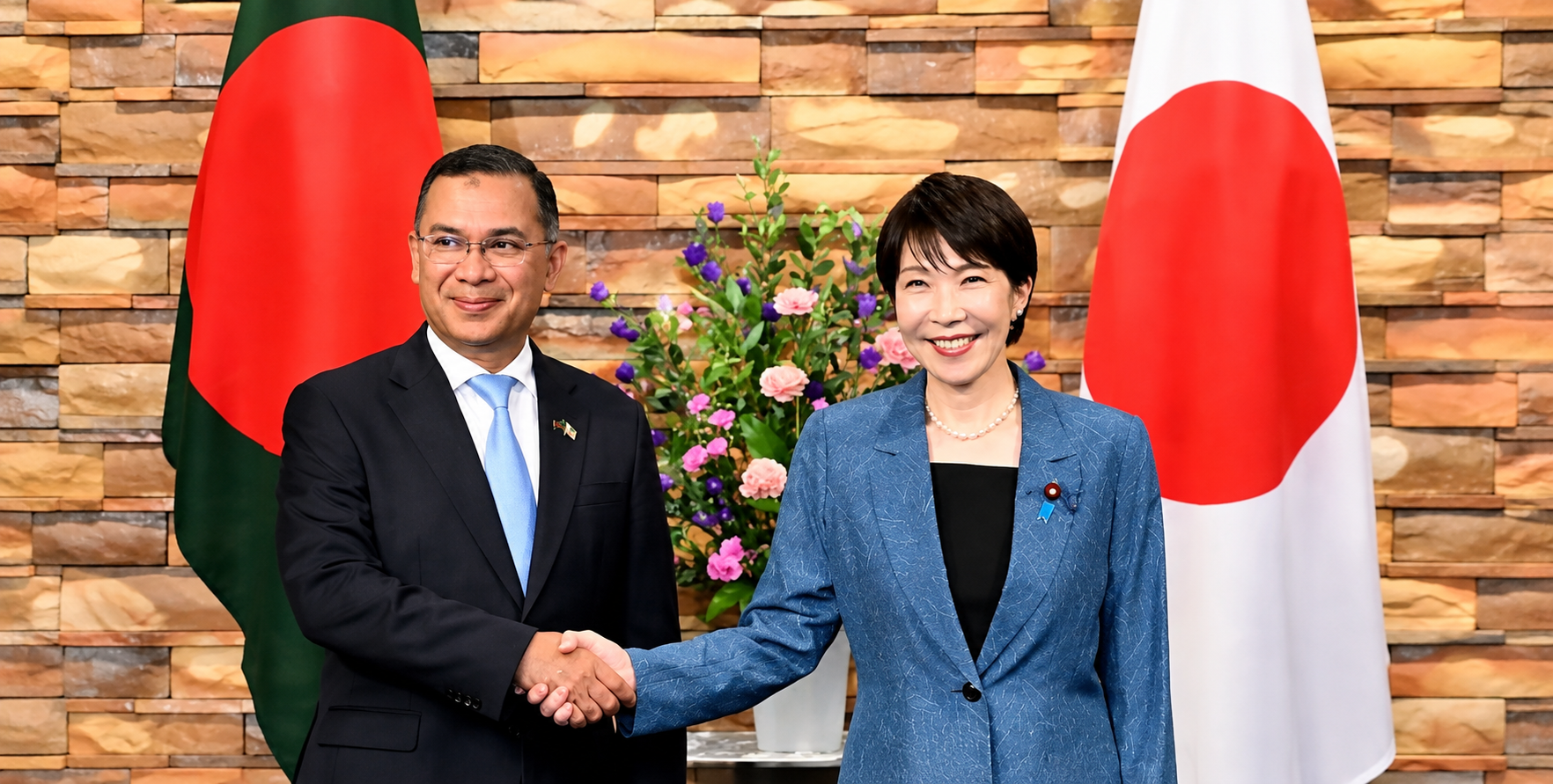
Japan’s growing engagement with Bangladesh is increasingly moving beyond traditional economic cooperation. While trade, foreign investment, infrastructure development and employment opportunities remain important elements of bilateral relations, Tokyo appears to have a much broader strategic vision for its partnership with Dhaka.
The recent visit of Prime Minister Tarique Rahman to Japan, following the elevation of bilateral relations to a strategic partnership in April 2023, has brought this emerging relationship into sharper focus. The agreements and initiatives announced during the visit indicate that Japan is interested not only in Bangladesh’s economic potential but also in its geographical position, maritime significance and growing importance in the Indo-Pacific region.
For Bangladesh, the relationship offers considerable opportunities. However, understanding Japan’s long-term strategic objectives is essential to ensuring that cooperation serves the country's national interests.
A Partnership Built Over Five Decades
Japan has maintained a longstanding relationship with Bangladesh since the country's independence in 1971. Japan recognised Bangladesh in February 1972 and gradually emerged as one of its major development partners.
Between 1972 and 2022, Japan provided approximately $24.72 billion in grants and loans to Bangladesh, primarily through the Japan International Cooperation Agency (JICA).
Japanese financial and technical assistance has contributed to several major infrastructure projects, including roads, bridges, transport facilities and energy-related developments.
The relationship was upgraded to a comprehensive partnership in 2014 and subsequently elevated to a strategic partnership in 2023. These developments demonstrate that cooperation between the two countries has gradually expanded beyond conventional development assistance.
The Bay of Bengal: Japan’s Strategic Priority
One of the most significant reasons behind Japan’s growing interest in Bangladesh is the Bay of Bengal.
Bangladesh occupies a strategically important geographical position connecting South Asia and Southeast Asia. The Bay of Bengal also serves as an important maritime corridor linking major international trade routes.
Japan depends heavily on imported energy, minerals, raw materials and food products. Consequently, the security of international shipping routes is essential to its economic stability.
A substantial portion of Japan’s maritime trade passes through the Indian Ocean, with many shipping routes connected to the Bay of Bengal.
For Tokyo, maintaining secure maritime access, freedom of navigation and stable regional connectivity is therefore a major strategic consideration.
Closer cooperation with Bangladesh provides Japan with an opportunity to strengthen its engagement in this strategically important maritime region.
BIG-B: An Economic Initiative with Geopolitical Significance
Japan's Bay of Bengal Industrial Growth Belt (BIG-B) initiative represents another important dimension of its long-term strategy.
The initiative seeks to promote industrial development, improve infrastructure, strengthen energy connectivity and expand regional trade.
During Prime Minister Tarique Rahman's recent visit, the initiative was upgraded to "BIG-B for Shared Prosperity".
The expanded framework places greater emphasis on integrating power, energy, deep-sea port, industrial and information and communication technology infrastructure.
The Matarbari deep-sea port project in Cox's Bazar is particularly important in this context. Supported by Japanese financing and technical cooperation, the project is expected to strengthen Bangladesh's maritime connectivity and facilitate international trade.
However, the strategic importance of Matarbari extends beyond commercial considerations. It could also strengthen Japan's long-term economic and strategic presence in the Bay of Bengal.
China’s Growing Influence and Japan’s Response
The intensifying strategic competition between China and the United States has created new geopolitical realities across the Indo-Pacific.
Bangladesh's geographical position, infrastructure requirements and growing economic importance have made it increasingly relevant to major regional and global powers.
China has become an important development and defence partner of Bangladesh, supporting various infrastructure projects and supplying a significant portion of the country's military equipment.
Japan, meanwhile, is seeking to expand its strategic engagement with Dhaka and diversify Bangladesh's international partnerships.
The proposed Chinese-backed deep-sea port project on Sonadia Island was eventually shelved, while Japan-backed development of the Matarbari port gained momentum.
This shift illustrates how infrastructure development in Bangladesh can carry geopolitical implications beyond its immediate economic value.
Japan's engagement should therefore be understood partly within the broader context of its interest in maintaining a favourable strategic balance in the Indo-Pacific.
Maritime Security and Defence Cooperation
Another important development in Bangladesh-Japan relations is the expansion of defence and maritime security cooperation.
Historically, Japan maintained considerable restrictions on overseas defence-related cooperation because of its post-Second World War pacifist security framework.
However, Japan has gradually expanded its security role in response to changing regional threats and strategic challenges.
Its constitutional interpretation of Article 9 was revised in 2014 to permit limited collective self-defence under certain conditions.
In recent years, Japan has increased its defence expenditure, modernised its military capabilities and strengthened its maritime security framework.
For Bangladesh, this changing Japanese security policy creates opportunities for cooperation in maritime surveillance, naval technology, coastal security and defence capacity development.
Japan has already provided patrol boats to Bangladesh under its Official Security Assistance (OSA) programme. It has also entered into a defence equipment and technology transfer agreement with Bangladesh.
During the recent visit, Japan committed $13.44 million towards the acquisition of a patrol vessel.
These developments suggest that maritime security is becoming an increasingly important component of bilateral relations.
For Tokyo, stronger maritime cooperation with Dhaka can help protect regional shipping routes. For Bangladesh, it offers opportunities to improve maritime security capabilities and diversify its defence partnerships.
Diplomatic Cooperation and International Influence
Japan's objectives in Bangladesh are not limited to infrastructure, trade and security. Diplomatic cooperation is another significant dimension of the relationship.
Tokyo seeks support from international partners on several important global and regional issues.
Bangladesh has expressed support for Ukraine's territorial integrity and raised concerns regarding North Korea's missile activities. In the recent joint statement, Dhaka also shared Japan's concerns about North Korea's nuclear programme and the issue of Japanese citizens abducted by North Korea.
Furthermore, Bangladesh expressed support for Japan's aspiration to become a permanent member of the United Nations Security Council.
Japan, in turn, recognised Bangladesh's humanitarian contribution in hosting Rohingya refugees and supported the need for a sustainable solution to the crisis in Myanmar.
Such diplomatic alignment reflects the growing political dimension of the bilateral partnership.
Bangladesh Must Protect Its Strategic Autonomy
Japan's growing interest in Bangladesh presents substantial economic and strategic opportunities. Japanese investment, infrastructure financing, technological cooperation and maritime assistance can contribute significantly to the country's long-term development.
Nevertheless, Bangladesh must approach these opportunities with a clear understanding of the geopolitical environment.
The country maintains important relationships with China, India, the United States, Japan and other international partners. Each relationship serves different economic, political and security interests.
Bangladesh should avoid becoming overly dependent on any single power or becoming entangled in the strategic rivalry between major countries.
Instead, its foreign policy should prioritise national interests, economic independence, regional stability and diplomatic flexibility.
A balanced approach would enable Bangladesh to attract investment from Japan while maintaining constructive relations with China and other development partners.
Conclusion
Japan's engagement with Bangladesh is evolving into a relationship that extends well beyond conventional economic cooperation. Trade, investment and infrastructure remain important, but maritime security, regional connectivity, defence cooperation and geopolitical influence are becoming increasingly significant.
The Bay of Bengal is emerging as a critical strategic space in the Indo-Pacific, and Bangladesh's geographical position gives it considerable diplomatic and geopolitical importance.
For Dhaka, the challenge is to convert this growing international attention into tangible national benefits without compromising its sovereignty or strategic independence.
Ultimately, Bangladesh needs a foreign policy that combines economic pragmatism with geopolitical foresight. By maintaining balanced relations with major powers and negotiating partnerships from a position of national interest, the country can strengthen its economy, improve maritime security and enhance its influence in regional and international affairs.
The real strategic opportunity for Bangladesh lies not in choosing between competing global powers, but in ensuring that every partnership contributes to its long-term national interests.
Comments
No comments yet. Be the first.
Related Stories
Related Stories

First published 1 November 2026. Spotted an error? Read our corrections policy.