
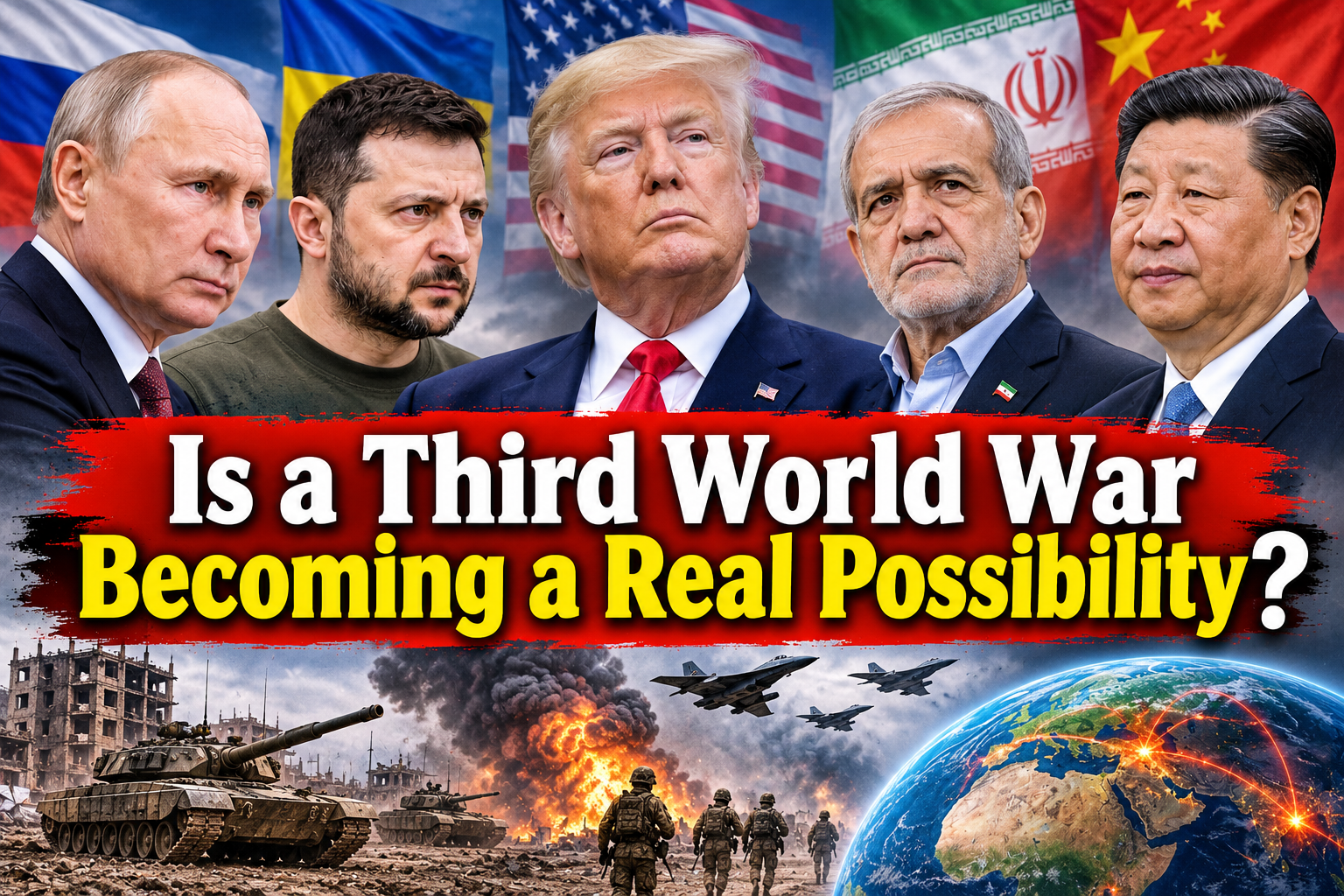
The world is going through one of the most turbulent periods in modern history. International relations have become more unstable than at any point since the end of the Cold War, while growing tensions among major powers are fragmenting the global system. The old international order, despite its limitations, has steadily eroded.
A major shift in the balance of power is transforming global politics and accelerating the emergence of a multipolar world. At the same time, powerful states and regional actors are increasingly disregarding international law and established norms. Countries are therefore being forced to navigate an increasingly uncertain environment in which military strength and coercive power are once again playing a central role.
The use—or even the threat—of force is increasingly being treated as a first option rather than a last resort. Diplomatic efforts often appear only after military action has already begun.
Conflicts have multiplied across the globe. The wars involving Israel and Iran and Russia and Ukraine, Israel's devastating campaign in Gaza, and its military operations against neighbouring countries are among the most serious examples. Research from a Swedish university indicates that 2025 saw the highest number of interstate conflicts since the Second World War, with 65 active conflicts recorded during the year. The danger of a wider international confrontation is consequently growing.
Could these conflicts lead to another world war?
This question has gained renewed attention in recent years. British columnist Gideon Rachman's book War Is Interested in You: The Breakdown of International Order and the Threat of World War Three, published in October 2026, examines why the international system appears increasingly vulnerable to major conflict.
The title draws on Leon Trotsky's famous observation that people may not be interested in war, but war can still become interested in them. The broader message is that societies cannot assume they will remain untouched simply because they do not seek conflict.
Rachman identifies three major factors behind the deterioration of the international order.
First, the global balance of power is changing, challenging the dominance that the United States has exercised for decades. Second, increasingly assertive leaders—often described as strongmen—view military power as a legitimate means of achieving political objectives. Third, the combination of these developments is weakening international rules and institutions.
In Rachman's view, the world is gradually moving away from a system governed by law toward one in which military and economic power increasingly determine outcomes.
The relative decline of Western influence and America's reduced willingness to play the role of global guarantor have created greater room for powers dissatisfied with the existing order to take risks. Russia's invasion of Ukraine and China's increasingly assertive position regarding Taiwan illustrate this changing environment. The US use of military force against Iran has also, according to Rachman, contributed to the weakening of international norms.
The return of great-power rivalry
The rise of leaders such as Vladimir Putin, Donald Trump and Benjamin Netanyahu has further complicated the international environment. Their approaches challenge traditional assumptions about a rules-based global order and place greater emphasis on national power, territorial interests and spheres of influence.
Rachman argues that both Trump and Putin have shown sympathy for the idea that major powers should have recognised spheres of influence. Trump’s renewed emphasis on the Monroe Doctrine is presented as one example of this approach.
As the rules governing international relations weaken, countries are increasing defence spending and preparing for a more uncertain security environment. The erosion is not limited to armed conflicts. Economic confrontation, protectionism and trade wars can also undermine international cooperation and weaken institutions.
Are today's conflicts becoming connected?
Rachman examines several major conflicts and argues that, although they remain largely regional, they increasingly intersect. His concern is that separate conflicts could eventually become connected and create a much wider confrontation.
However, the idea of a unified anti-Western bloc involving Russia, China, North Korea and Iran deserves caution. These countries may share opposition to aspects of US dominance, but their strategic interests are not identical. They do not necessarily constitute a coherent alliance acting according to a common plan.
Indeed, the relationships among these countries contain significant limitations and tensions. The partnership between Russia and China, for example, has clear boundaries, while the interests of all four states frequently diverge.
Are we actually heading towards World War III?
Rachman's answer is cautious rather than alarmist.
He argues that a genuine world war would have two defining characteristics. First, the world's major powers would need to become directly involved in fighting each other, as happened during the First and Second World Wars. Second, the conflict would have to spread across multiple continents.
Neither condition currently exists on that scale. Nevertheless, neither can be completely ruled out in the future.
Among the greatest dangers is a direct confrontation between the United States and China, particularly over Taiwan. Such a conflict could potentially involve other major powers and transform a regional crisis into a much broader international war.
South Asia remains a serious flashpoint
Rachman also discusses the 2025 military confrontation between India and Pakistan. Although his treatment adds relatively little to the existing analysis of the crisis, he highlights an important concern: the risks of a major conflict in South Asia often receive less international attention than other global flashpoints.
The danger is particularly serious because both India and Pakistan possess nuclear weapons and have continued to develop increasingly sophisticated military capabilities.
A future crisis between the two countries could therefore carry consequences far beyond the immediate region.
A warning rather than a prediction
The world is not necessarily on the verge of a third world war. Today's conflicts remain largely separate, and the major powers have so far avoided direct, sustained military confrontation with one another.
Yet the international environment is clearly becoming more dangerous. The weakening of international institutions, growing rivalry among major powers, the return of military coercion and the rise of leaders willing to challenge established norms have created conditions in which miscalculation could have devastating consequences.
Rachman's book is therefore valuable not because it predicts an inevitable world war, but because it draws attention to the gradual erosion of the mechanisms that once helped prevent major-power conflict.
The central warning is simple: wars do not always begin with a deliberate decision to start a world war. They can emerge when smaller conflicts intersect, diplomatic safeguards fail and competing powers underestimate the consequences of escalation.
The world may not yet be sleepwalking into World War III—but the growing number of conflicts and the weakening of international restraints make it increasingly important for governments to recognise how quickly regional crises can become global ones.
Comments
No comments yet. Be the first.
Related Stories
Related Stories

First published 6 November 2026. Spotted an error? Read our corrections policy.