
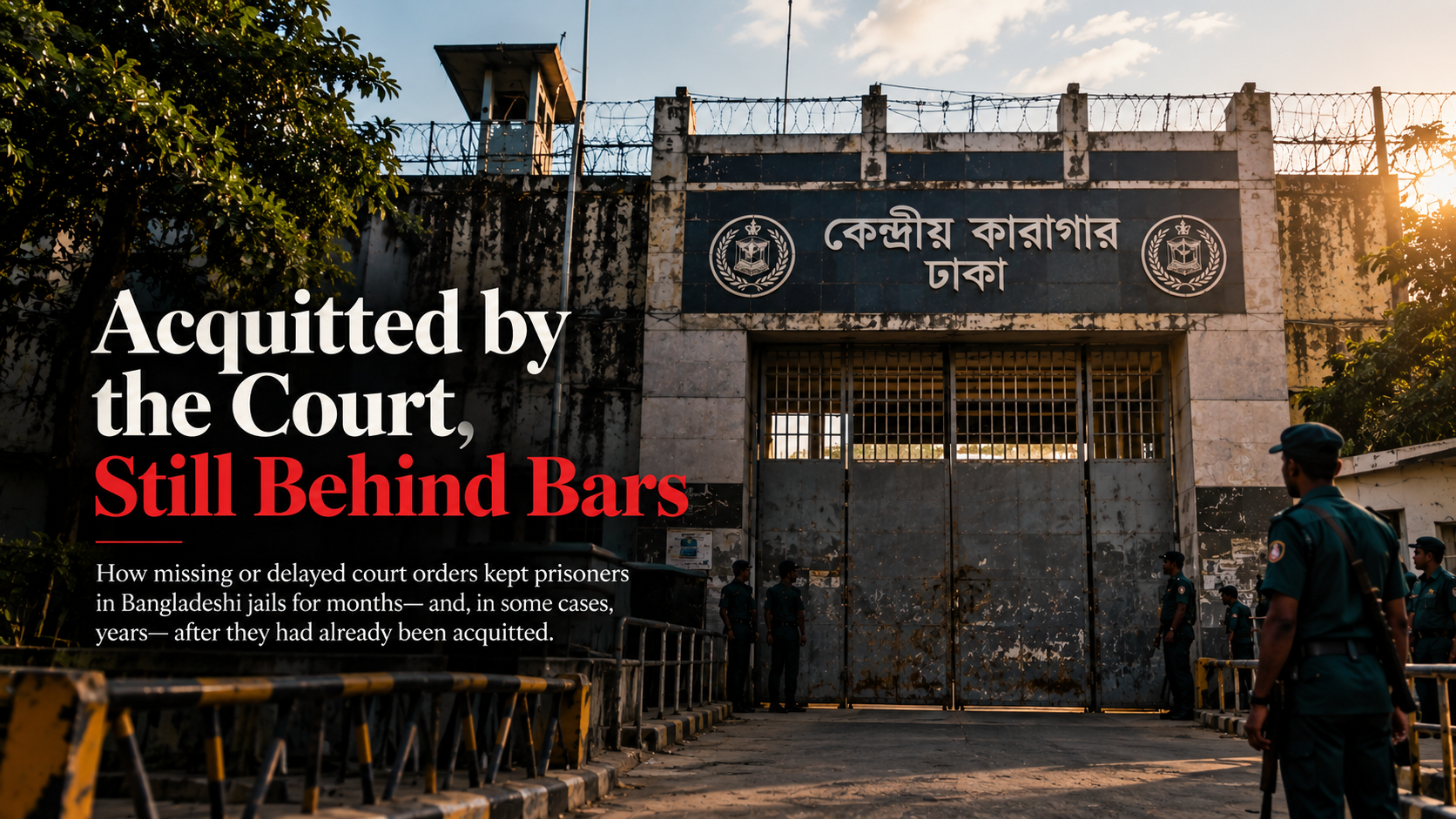
A court acquits a prisoner. The conviction is overturned, the sentence is set aside and the law says he should be released. Yet for some prisoners in Bangladesh, freedom does not come when the judge delivers the verdict. It comes only when a piece of paper carrying that verdict reaches the prison authorities.
In several documented cases, that paper did not arrive—or arrived years too late. The result was a disturbing gap between what the court ordered and what actually happened: people remained in custody long after they had legally won their freedom. In some cases, they spent months behind bars; in others, they lost several years of their lives. At least one man died before the administrative process required to implement his acquittal was completed.
The case of Shukur Ali is perhaps the most striking example. Sentenced to death in a murder case, Ali was acquitted by the High Court on 27 May 2012. The court ordered his release if he was not wanted in any other case. But he remained in prison. According to reports, the order granting him freedom did not reach the prison authorities. For years, the judicial decision existed on paper while Ali continued to live behind bars. He eventually secured his release roughly 12 years after his acquittal, after the matter came to wider attention. The Chief Justice later ordered an investigation into how a man could remain imprisoned for so long after being acquitted.
Shukur Ali's case was not an isolated incident. Ibrahim Ali Sheikh, who had also been sentenced to death in a murder case, was acquitted by the High Court in 2017. But the release order did not reach Jessore Central Jail. He remained imprisoned for approximately eight years after his acquittal. The issue was eventually brought to the attention of the prison authorities, who contacted the court and obtained the relevant order. The document reached the jail in February 2025, after which Ibrahim was finally released. The case later raised a separate question of compensation for the years he spent in custody despite having already been acquitted.
Then there is the case of Abul Kashem, which shows how a breakdown in communication between different levels of the judicial system can have devastating consequences. Kashem had been sentenced to death in a murder case, but the High Court later acquitted him. The acquittal order reached the Additional Chattogram District and Sessions Judge's Court, but it did not reach the prison authorities. Kashem remained behind bars for seven years, three months and 11 days, including years in a condemned cell. When the matter eventually came before the High Court, the court ordered a judicial inquiry into how a person who had already been acquitted could remain imprisoned for so long.
Jabed Ali's case illustrates another point in the chain where things can go wrong. The High Court acquitted him on 19 March 2003. The order reached the relevant lower court several days later, but instead of being acted upon and communicated to the prison, it was reportedly kept in the court's records. The prison therefore did not receive the information necessary to release him. Jabed Ali remained in custody for roughly 13 years after his acquittal before he was eventually released. Reports on the case also said that he repeatedly tried to learn about the status of his case while in prison.
The pattern becomes even more troubling when viewed through the case of Torab Ali. Ali, a former local political leader and former BDR member, had been sentenced to life imprisonment in connection with the 2009 Pilkhana killings. The High Court acquitted him on 27 November 2017. But the order had not reached the prison authorities. Ali was elderly and seriously ill. He was taken to Dhaka Medical College Hospital after falling sick and died there on 5 January 2018, before the administrative process necessary to secure his release had been completed. Contemporary reports specifically identified the failure to communicate the High Court's acquittal order to the prison authorities.
These cases are different in their legal histories, but they reveal the same structural vulnerability. A judicial order does not necessarily travel directly from the courtroom to the prison. In a system that still relies heavily on physical documents and multiple administrative handoffs, an acquittal may have to pass through several stages before it becomes a release at the prison gate. The order must be prepared, signed, processed and dispatched; it may then have to reach the relevant lower court, be verified, forwarded to the prison and processed by prison officials. Every stage presents another opportunity for delay, error or loss.
For a routine administrative document, such a delay might be inconvenient. For an acquittal order, it can amount to continued deprivation of liberty.
That raises a fundamental question: when a court orders a prisoner's release, how does the justice system know that the order has actually reached the institution holding that person?
The documented cases suggest that this question does not have a sufficiently reliable answer. In some instances, families or lawyers have had to intervene after discovering that a person who had already been acquitted was still in prison. In others, prison officials themselves had to contact the court and obtain copies of orders that should already have been available to them. The very fact that these cases can persist for years suggests that there may be no consistently functioning mechanism that automatically alerts the relevant prison when a prisoner's conviction is overturned.
The problem is therefore larger than a missing document. It is a question of whether the justice system has an effective mechanism for translating judicial decisions into real-world outcomes.
A court can determine that a person should no longer be imprisoned. But if the decision does not reach the institution holding that person, the judgment remains theoretical. The prisoner remains physically confined even though the legal basis for that confinement may have disappeared.
There is also a crucial distinction that must be made in examining these cases. An acquittal does not automatically mean that a prisoner must be released if he is lawfully detained in another case. Courts and prison authorities must verify whether another warrant, conviction or pending case provides a separate legal basis for custody. But where the records establish that there is no such separate basis and the only obstacle is the failure to communicate or implement the acquittal, the issue becomes much more serious.
In such cases, the question is no longer simply whether the original conviction was wrong. It is whether the state continued to deprive someone of liberty after its own judiciary had ordered otherwise.
The human cost is difficult to quantify. Twelve years in prison is not merely a number. It is twelve years of family life, employment, education, relationships and personal freedom that cannot be recovered. Eight years can transform a person's entire life. For someone kept in a condemned cell after being acquitted, every additional day carries a psychological burden that is difficult to measure. And in Torab Ali's case, the consequences were irreversible: the court had restored his legal freedom, but the system failed to complete the process before his death.
This also raises a question of accountability. When a person is sent to prison, the state maintains detailed records: the warrant, conviction, sentence, prison admission and custody status are all documented. Why should the same system not have an equally reliable mechanism for tracking an acquittal from the moment the order is issued until the moment the prisoner walks out of the gate?
A functioning system could be relatively straightforward. Once a court issues a release order, the order should be electronically transmitted to the relevant prison, acknowledged by the receiving authority and tracked until the prison confirms that the person has been released. If the order is not acknowledged within a defined period, the issuing court should be alerted. Such a system would not eliminate every administrative error, but it would make it much harder for an acquitted person to disappear into a gap between government offices.
Bangladesh's broader move towards digitalisation of the judiciary makes this question even more relevant. Digitising judgments alone is not enough. What matters is whether critical judicial decisions—particularly those involving a person's liberty—can be tracked from issuance to implementation.
The cases of Shukur Ali, Ibrahim Ali Sheikh, Abul Kashem, Jabed Ali and Torab Ali point to the same uncomfortable reality: a court can give a person his freedom, but the administrative machinery can still fail to deliver it.
The justice system therefore faces a question that goes beyond these individual cases. When a judge says, “Release him,” there should be no uncertainty about whether the prison has received the message.
Because for the person behind the bars, the difference between a court order and an actual release is not administrative.
It is freedom.
And freedom delayed for years is not justice delivered.
Comments
No comments yet. Be the first.
Related Stories
Related Stories

First published 5 October 2026. Spotted an error? Read our corrections policy.