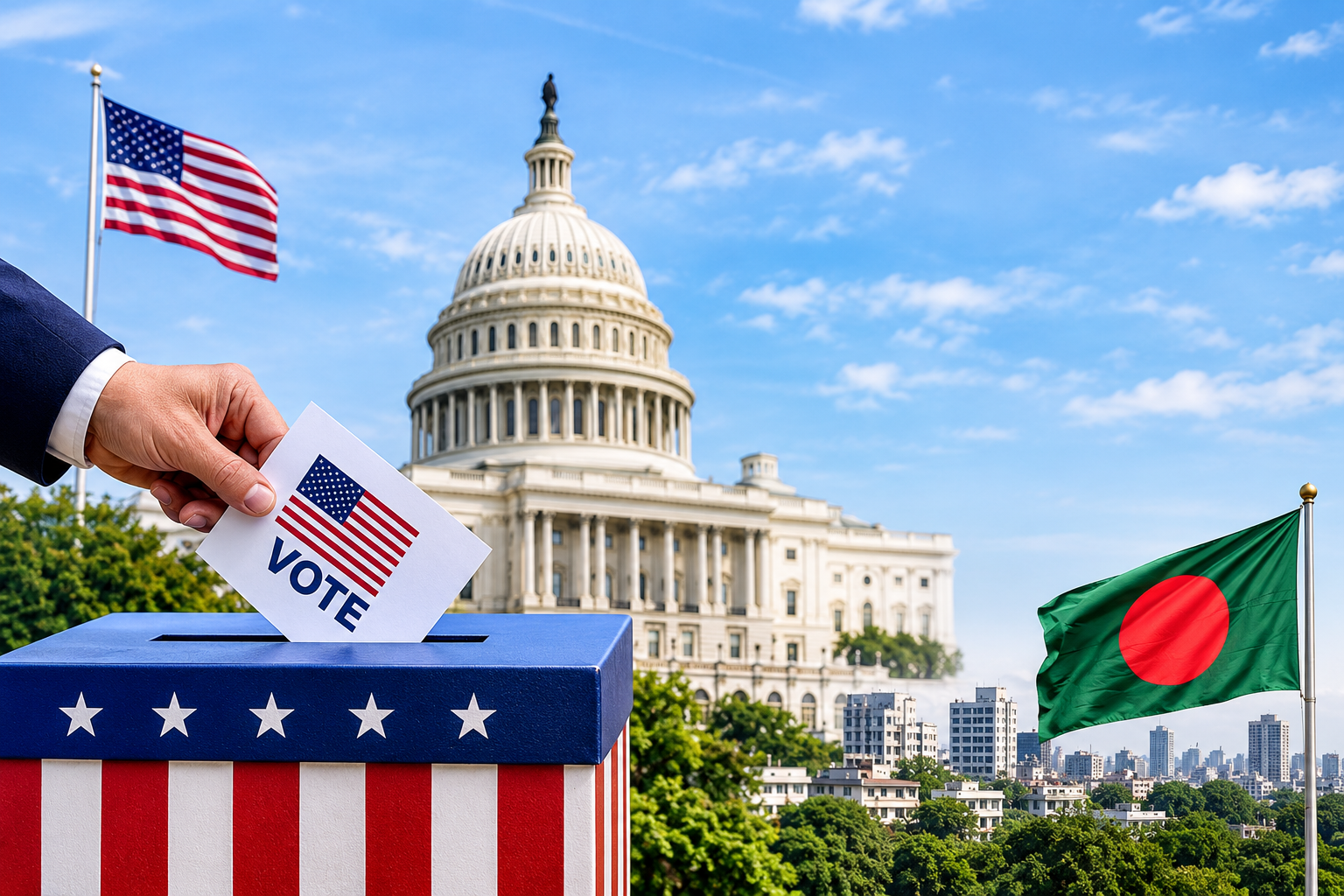
The 2026 US midterm elections are not merely an internal political contest in the United States. Their outcome could have significant implications for Bangladesh's economy, export trade, energy security, foreign debt and international economic relations.
On November 3, American voters will elect all members of the House of Representatives and approximately one-third of the Senate. If the Democrats gain control of Congress, they could impose greater institutional checks on President Donald Trump's administration.
For Bangladesh, this election is particularly important because the country has faced the economic consequences of several Washington policy decisions over the past two years without having any direct influence over them.
### 1\. US Tariff Policy and Bangladesh's Garment Exports
One of Bangladesh's biggest concerns is the changing US trade policy.
Since April 2025, Washington has revised tariffs on Bangladeshi goods several times. Initially, the US announced a 37 percent tariff, which was reduced to 20 percent in August. A trade agreement signed on February 9, 2026, subsequently brought the rate down to 19 percent.
However, the US Supreme Court later questioned the president's authority to impose those tariffs under the emergency law. A temporary 10 percent tariff followed, before the administration introduced another measure under Section 301 of the Trade Act in July.
These repeated changes have created considerable uncertainty for Bangladeshi exporters.
The United States purchases approximately one-fifth of Bangladesh's garment exports. Therefore, the stability and predictability of US trade policy are just as important as the actual tariff rate.
If Democrats secure a majority in the House, they could investigate trade decisions, organise congressional hearings and increase scrutiny of the administration's policies. Such oversight could raise the political cost of imposing additional tariffs.
However, a Democratic victory would not automatically guarantee lower tariffs for Bangladesh. Democrats have traditionally placed greater emphasis on labour rights, workplace safety and supply-chain transparency.
Following the Rana Plaza disaster in 2013, the Obama administration suspended Bangladesh's trade preferences. Therefore, Bangladesh's garment industry must also prepare for stronger scrutiny of labour standards and factory conditions.
### 2\. Iran War, Energy Crisis and Bangladesh's Economy
The economic consequences of the US-led war against Iran represent another major concern for Bangladesh.
The closure of the Strait of Hormuz has disrupted international energy supplies and significantly increased fuel prices.
All three of Bangladesh's long-term LNG suppliers declared force majeure following the disruption. QatarEnergy subsequently halved its scheduled LNG deliveries for 2026.
As a result, Bangladesh has had to purchase more than 30 LNG cargoes from the international spot market. Some of these shipments have reportedly cost twice as much as they did before the war.
This situation has increased pressure on Bangladesh's electricity generation, industrial production costs and overall inflation.
If Democrats gain control of Congress, they could organise hearings on the financial and economic costs of the war, demand repeated votes on war powers and seek to impose conditions on funding for the prolonged conflict.
Although Congress cannot directly reopen the Strait of Hormuz, greater political pressure could encourage diplomatic negotiations and a possible settlement.
An end to the conflict could help stabilise international energy markets, potentially reducing Bangladesh's fuel import costs.
### 3\. A Strong US Dollar and Bangladesh's Foreign Debt
Another significant concern is the impact of US economic policy on Bangladesh's foreign debt obligations.
Bangladesh repaid a record $4.49 billion in foreign debt during the 2025–26 fiscal year. According to government projections, annual debt-servicing payments could approach $7.6 billion by 2028–29.
Higher energy prices have contributed to inflationary pressure in the United States. In response, the Federal Reserve has raised interest rates and indicated that further increases may follow.
Higher US interest rates make dollar-denominated assets more attractive to international investors. This can strengthen the US dollar against other currencies.
For Bangladesh, a stronger dollar means that more taka is required to repay the same amount of foreign debt. It also increases the cost of importing fuel and other essential commodities.
Furthermore, disagreements over US government borrowing and federal spending could create additional uncertainty in international financial markets.
A Democratic-controlled Congress might challenge government spending proposals considered financially unsustainable. However, a change in congressional control alone would not necessarily reduce oil prices or weaken the dollar.
### 4\. Changes in US Leadership in the Global Economic Order
For nearly 80 years, the United States has played a leading role in establishing and maintaining the international economic order.
Its contributions have included:
* Promoting open markets and international trade.
* Supporting a rules-based global trading system.
* Establishing mechanisms for resolving international trade disputes.
* Providing development financing to developing countries.
* Supporting multilateral economic cooperation.
Bangladesh's export-oriented industries, particularly the garment sector, have benefited considerably from this international system.
For decades, Bangladesh operated under the assumption that trade preferences and market-access arrangements negotiated with international partners would remain relatively stable.
However, recent unilateral tariff decisions, reductions in foreign assistance and disputes over the legal foundations of trade agreements have raised questions about the reliability of the existing international economic order.
A Democratic majority in Congress could signal renewed American support for multilateral cooperation, international trade rules and institutional accountability.
### 5\. The World Bank and Concessional Development Financing
Another important issue for Bangladesh is access to concessional financing from institutions such as the World Bank's International Development Association (IDA) and the Asian Development Fund.
According to World Bank figures, Bangladesh had approximately $22.7 billion in outstanding IDA loans as of March 2026, making it the institution's largest borrower.
These institutions provide developing countries with low-interest or interest-free financing for infrastructure, poverty reduction and other development projects.
The US Congress plays an important role in approving American financial contributions to these institutions.
However, last year, a Republican-led House Appropriations Committee approved a spending bill that excluded contributions to both the IDA and the Asian Development Fund.
The US administration's proposed budget for the next fiscal year also seeks to reduce its World Bank contribution from approximately $1.07 billion to $867 million.
If Democrats gain control of the House, they may be more inclined to protect funding for international development institutions.
Otherwise, Bangladesh could become increasingly dependent on alternative financing sources, including China, Gulf countries and the BRICS New Development Bank.
However, borrowing from these sources may involve higher interest rates, different commercial conditions or additional geopolitical considerations.
Bangladesh must therefore carefully assess alternative financing arrangements in line with its long-term national interests.
### 6\. The Political Significance of the Election for Bangladesh
Even if Democrats win the midterm elections, they will not automatically gain the power to reverse all presidential decisions.
Overriding a presidential veto requires a two-thirds majority in both chambers of Congress. Therefore, a Democratic majority alone would not guarantee fundamental changes in US foreign or economic policy.
Nevertheless, a change in congressional control could increase investigations, public hearings, legislative scrutiny and political accountability.
This would be particularly important in areas such as trade policy, military engagement and international development financing.
Bangladesh cannot vote in the US elections, but it will have to live with their economic and diplomatic consequences.
### Overall Assessment: What Does Bangladesh Need?
Bangladesh's interests in the US midterm elections should not be defined simply by the victory of one political party.
Instead, the country needs a stable, predictable and rules-based international economic environment.
Its key priorities include:
* Trade stability: Predictable US tariff policies and reliable access to the American market.
* Energy security: An end to the Iran conflict and the restoration of stability in international energy markets.
* Debt management: Greater stability in the US dollar and international financial markets.
* Development financing: Continued access to concessional loans from international financial institutions.
* Global economic cooperation: Stronger commitment to multilateral institutions and rules-based international trade.
Ultimately, the 2026 US midterm elections are far more than a domestic political event in America. Their outcome could influence Bangladesh's export earnings, foreign debt management, energy security and long-term economic development.
For Bangladesh, the greatest expectation is not necessarily a change of political leadership in Washington, but a return to institutional balance, international cooperation and greater predictability in American policymaking.
Editorial note: This is a rewritten English version of the article supplied by the user. The original arguments, figures and key information have been retained, but the information has not been independently fact-checked.
Comments
No comments yet. Be the first.
Related Stories
Related Stories
First published 4 November 2026. Spotted an error? Read our corrections policy.