
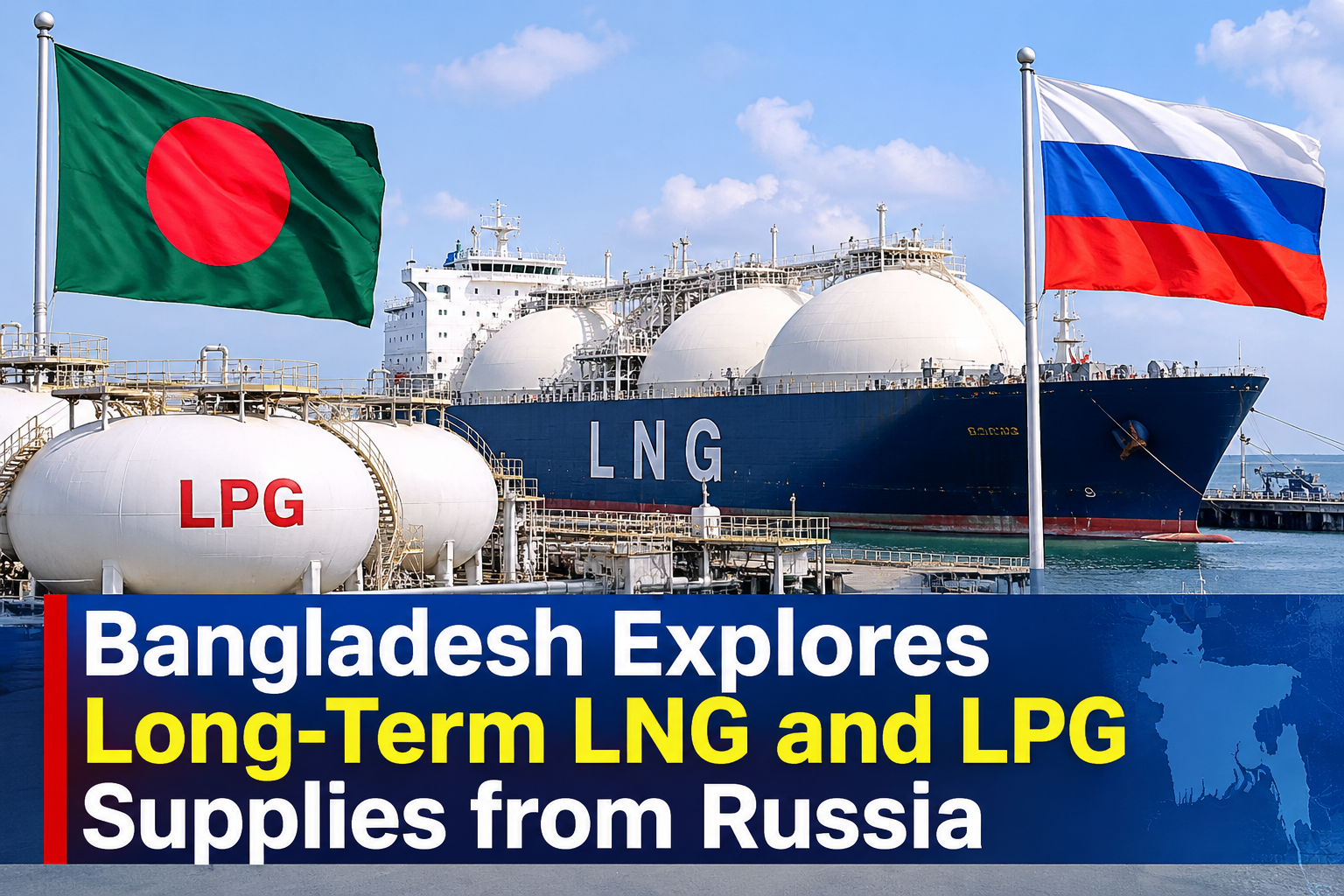
Bangladesh is exploring the possibility of securing long-term supplies of liquefied natural gas (LNG) and liquefied petroleum gas (LPG) from Russia as the country seeks to meet rising energy demand.
The issue was discussed at the fifth meeting of the Bangladesh-Russia Intergovernmental Commission on Trade, Economic, Scientific and Technical Cooperation, held in Dhaka on 5 November.
The talks included potential LNG imports from Russia’s Sakhalin-2 project and the Portovaya LNG facility. Russia also discussed possible supplies from the Ust-Luga plant as part of broader energy cooperation.
Russian state-owned energy giant Gazprom indicated that it could facilitate direct discussions between Petrobangla and Sakhalin Energy regarding LNG supplies from Sakhalin-2 if Bangladesh decides to pursue the option.
The two sides also discussed cooperation involving an ethane-rich gas processing complex, which could provide another avenue for expanding energy ties between the countries.
Russia proposes alternative payment mechanisms
Financial transactions were another major focus of the discussions. Russia is seeking alternative payment channels for bilateral trade as Western sanctions have complicated transactions through conventional international banking systems.
Moscow is particularly interested in establishing direct links between Russian banks and Bangladeshi financial institutions. The use of digital financial instruments for settling trade payments was also discussed.
The issue is especially relevant to Bangladesh because of difficulties in making repayments related to the Russian-funded Rooppur Nuclear Power Plant. Bangladesh Bank sources said money deposited with Sonali Bank for loan repayments cannot currently be transferred to the designated Russian bank because of sanctions.
Russia has previously proposed opening branches of Russian banks in Bangladesh, using the Indian rupee for trade settlements and creating an independent payment mechanism between the two countries.
According to documents from Bangladesh’s Economic Relations Division, Russia’s Exim Bank and the Russian Export Centre are interested in strengthening cooperation with Bangladeshi financial institutions and developing alternative payment arrangements. However, both institutions are subject to US sanctions, creating significant legal and financial challenges.
Bangladesh imported goods worth approximately $1.36 billion from Russia in FY2025, according to Bangladesh Bank data.
Broader energy and economic cooperation
Energy cooperation remains a key component of Bangladesh-Russia relations. Russia has played a major role in the Rooppur nuclear power project by providing financing, technology and technical assistance.
Gazprom has also been involved in Bangladesh’s oil and gas exploration sector since 2012, including drilling activities in Bhola.
At the latest intergovernmental commission meeting, both countries agreed to continue cooperation in oil and gas, the peaceful use of nuclear energy and the timely implementation of the Rooppur project.
The two sides are also seeking to expand cooperation in fertiliser supplies, agriculture, industrial production, investment, education, science and technology.
Meanwhile, Russia’s state development corporation VEB.RF and Invest Bangladesh are considering a memorandum of understanding aimed at strengthening information exchange and investment cooperation.
The Federation of Bangladesh Chambers of Commerce and Industry (FBCCI) and the Russia-Bangladesh Business Council have also signed an MoU to promote bilateral trade, investment and business cooperation.
The agreement, signed during the Bangladesh-Russia Business Dialogue in Dhaka, aims to improve the business environment through information sharing, joint projects, trade fairs, exhibitions, business missions and investment forums.
Business leaders from both countries called for the removal of existing trade barriers and the establishment of a reliable and sustainable payment mechanism, which they said could help unlock greater potential for bilateral trade and investment.
Comments
No comments yet. Be the first.
Related Stories
Related Stories
First published 6 November 2026. Spotted an error? Read our corrections policy.