
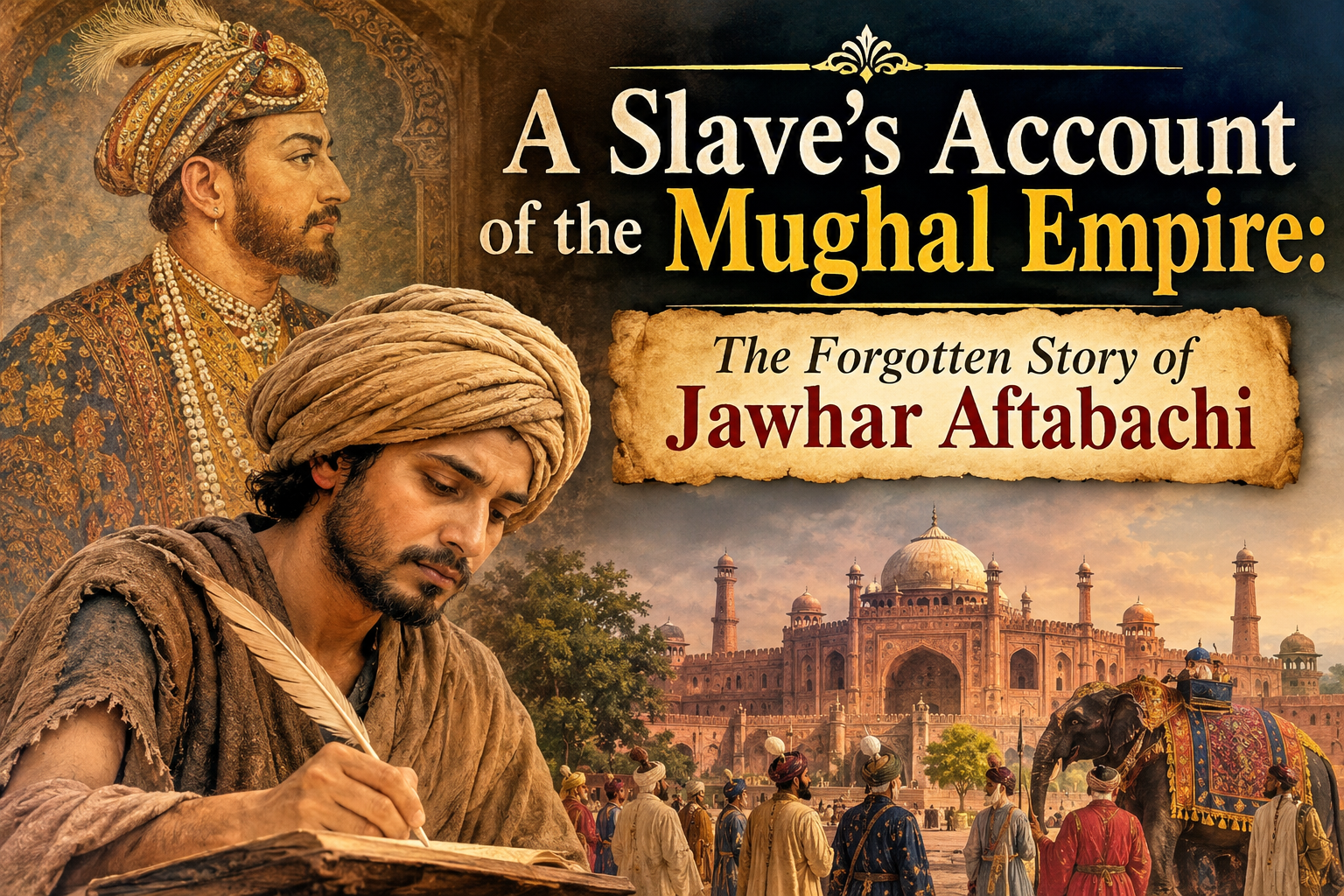
History is often told through the perspectives of kings, emperors and victorious rulers. However, one remarkable Persian manuscript from Mughal India offers a rare historical perspective from someone who occupied one of the lowest positions in society: an enslaved servant of an emperor.
The manuscript, titled Tazkirah-i Vaqiʻat, was written in 1587 during the reign of Mughal Emperor Akbar by Jawhar Aftabachi, a former personal attendant of Emperor Humayun. His account provides valuable insights into the Mughal court, military campaigns, administrative practices and the lives of enslaved individuals who served the imperial household.
Beyond documenting historical events, Jawhar's work reveals an ambitious but ultimately unsuccessful attempt by the early Mughals to establish a system of military slavery inspired partly by the traditions of the Delhi Sultanate and the contemporary Ottoman Empire.
From a Captured Child to an Imperial Attendant
Jawhar's early life was shaped by captivity and displacement. According to historical reconstruction, he was probably born in the early 1520s in a region north of the Black Sea, in an area corresponding to parts of present-day Russia, Ukraine or Poland.
As a child, he was reportedly captured during a raid by Crimean Tatars and sold into slavery to the Ottoman admiral Selman Reis.
Jawhar subsequently travelled through the Red Sea with the admiral's fleet during military operations against the Portuguese. When Selman Reis attempted to take his fleet to India, a mutiny broke out among the sailors, resulting in his death.
His nephew, Mustafa Bayram, retained control of three ships, several soldiers and the admiral's personal slaves, including the young Jawhar. The group eventually reached Gujarat.
The Ottoman Connection and Mughal Expansion
Upon arriving in Gujarat, Mustafa Bayram and his followers entered the service of Sultan Bahadur of Gujarat. The sultan welcomed these Ottoman military specialists, commonly known as Rumis, because of their expertise in firearms and gunpowder warfare.
Mustafa Bayram received the title of Rumi Khan and became an important military figure.
The growing military strength of Gujarat eventually brought Sultan Bahadur into conflict with the Mughal Empire. In 1535, Emperor Humayun launched an invasion of Gujarat.
Following Mughal victories, thousands of Ottoman and Abyssinian slaves came under Mughal control. Some were already serving in Gujarat's military establishment, while others entered Mughal service after their commanders changed allegiance.
This period marked the beginning of Jawhar's close association with Humayun and the Mughal imperial household.
Jawhar's Life Under Emperor Humayun
Jawhar initially served Humayun as a personal attendant, carrying a water vessel known as an aftaba so that the emperor could wash whenever necessary. This responsibility kept him close to the emperor and allowed him to witness private conversations, political developments and important military events.
His position gradually evolved beyond ordinary household service.
Jawhar's account describes several stages of advancement through which enslaved attendants could rise in the Mughal administration and military hierarchy.
His responsibilities included:
- Participating in royal hunting expeditions.
- Assisting in the organisation of military camps.
- Carrying out sensitive assignments on behalf of the emperor.
- Managing a village in Punjab.
- Supervising a provincial treasury in Lahore.
- Participating in military operations against Afghan forces.
- Advising Mughal commanders on artillery tactics influenced by Ottoman military practices.
One particularly disturbing assignment involved the blinding of Humayun's brother, Mirza Kamran. The experience reportedly affected Jawhar deeply, after which he was transferred to less violent administrative responsibilities.
While managing a village in Punjab, Jawhar also helped peasants escape debts imposed by Afghan landlords who had borrowed money against future agricultural production.
His career demonstrates that certain enslaved individuals could rise to positions of considerable administrative and military responsibility.
Military Slaves: An Important Part of Humayun's Army
Jawhar's account provides important evidence about the organisation of military slavery during Humayun's reign.
Historical references from Mirza Haydar Dughlat, Humayun's cousin, suggest that the Mughal army maintained a substantial number of enslaved military personnel.
According to his account, during the Battle of Kannauj in 1540, each Mughal general reportedly commanded approximately 500 slaves, while Humayun himself possessed around 17,000 pages or military slaves in training.
Although these figures may involve exaggeration, Jawhar's narrative provides valuable personal details about the individuals behind such statistics.
Many enslaved servants received specialised training and gradually advanced into positions of authority.
Some notable individuals mentioned in his account include:
Mihtar Vasil: An artillery commander who was sent to Kabul to procure military supplies but was captured and blinded by Humayun's rebellious brother Kamran.
Mihtar Sunbul: Initially responsible for delivering important messages, he later commanded approximately 60 slaves, became an artillery commander and eventually attained the rank of commander of a thousand.
Mihtar Yusuf: Began his career as a preparer of sweet drinks, later became a treasurer and eventually died in battle near Qandahar.
Sukhai: Responsible for managing Humayun's bedding, he reportedly saved the emperor's life in 1550 and later received administrative responsibility in Lahore. He was subsequently renamed Farhat Khan.
Nizam: Known as a water carrier, he saved Humayun from drowning during the Battle of Chausa. In recognition of his service, he was reportedly allowed to occupy the imperial throne for one day.
These examples illustrate how military and personal service could provide enslaved individuals with opportunities for advancement within the Mughal establishment.
The Relationship Between Slavery and Spiritual Discipleship
One of the most significant aspects of Jawhar's manuscript is the way it describes the relationship between an enslaved servant and the emperor.
Mughal nobles frequently emphasised their prestigious ancestry, claiming descent from Timur or Genghis Khan. Enslaved individuals, by contrast, lacked comparable social status and depended almost entirely on imperial favour for their advancement.
For Jawhar, Humayun was much more than a political ruler. He was a master, protector, father figure and, at times, a spiritually elevated personality.
This relationship allowed Jawhar to present his service as a form of spiritual discipleship rather than merely forced labour.
By portraying himself as a devoted disciple and eyewitness to the emperor's life, Jawhar transformed the narrative of his own social position.
His manuscript consequently became more than a historical record. It also represented an effort to establish dignity, recognition and personal value within a society dominated by hereditary aristocracy.
Akbar's Policy: From Slaves to Disciples
A significant development occurred during Emperor Akbar's reign.
According to the Mughal historian Abu al-Fazl, Akbar issued an order in March 1582 that resulted in the emancipation of thousands of slaves in Fatehpur Sikri.
He also instructed that the term ghulam, meaning slave, should no longer be used for members of the imperial establishment. Instead, they were to be described as chelas, meaning disciples.
Akbar questioned the appropriateness of using the term slave for individuals who had been forcibly captured and subsequently raised within the imperial household.
This change reflected an important political and cultural transformation in the Mughal understanding of personal loyalty and imperial service.
Jawhar composed his Tazkirah-i Vaqiʻat approximately five years after this decree.
The political environment of Akbar's court may therefore have influenced how Jawhar interpreted his earlier relationship with Humayun. His manuscript presented the emperor-servant relationship through the language of spiritual devotion and discipleship.
A Historical Record That Preserved a Forgotten Institution
Jawhar reportedly wrote his manuscript with the hope of receiving financial recognition from Emperor Akbar. His work primarily focused on Humayun, but it also preserved details about the experiences of enslaved soldiers, administrators and personal attendants.
The manuscript is particularly valuable because it records the development of an early Mughal military institution that eventually disappeared from historical memory.
It provides information about the origins, careers, responsibilities and social experiences of individuals who rarely received attention in conventional royal histories.
Jawhar's Tazkirah-i Vaqiʻat therefore offers historians a rare opportunity to examine the Mughal Empire from the perspective of someone who experienced its political and military transformation from within the imperial household.
His testimony reminds us that the history of empires was not shaped exclusively by kings and nobles. It was also influenced by enslaved servants, military specialists and ordinary individuals whose contributions often remained unrecorded.
Jawhar Aftabachi's greatest historical contribution was not simply documenting Emperor Humayun's life, but preserving the forgotten experiences of enslaved people who helped sustain the early Mughal Empire.
Comments
No comments yet. Be the first.
Related Stories
Related Stories
First published 2 November 2026. Spotted an error? Read our corrections policy.