
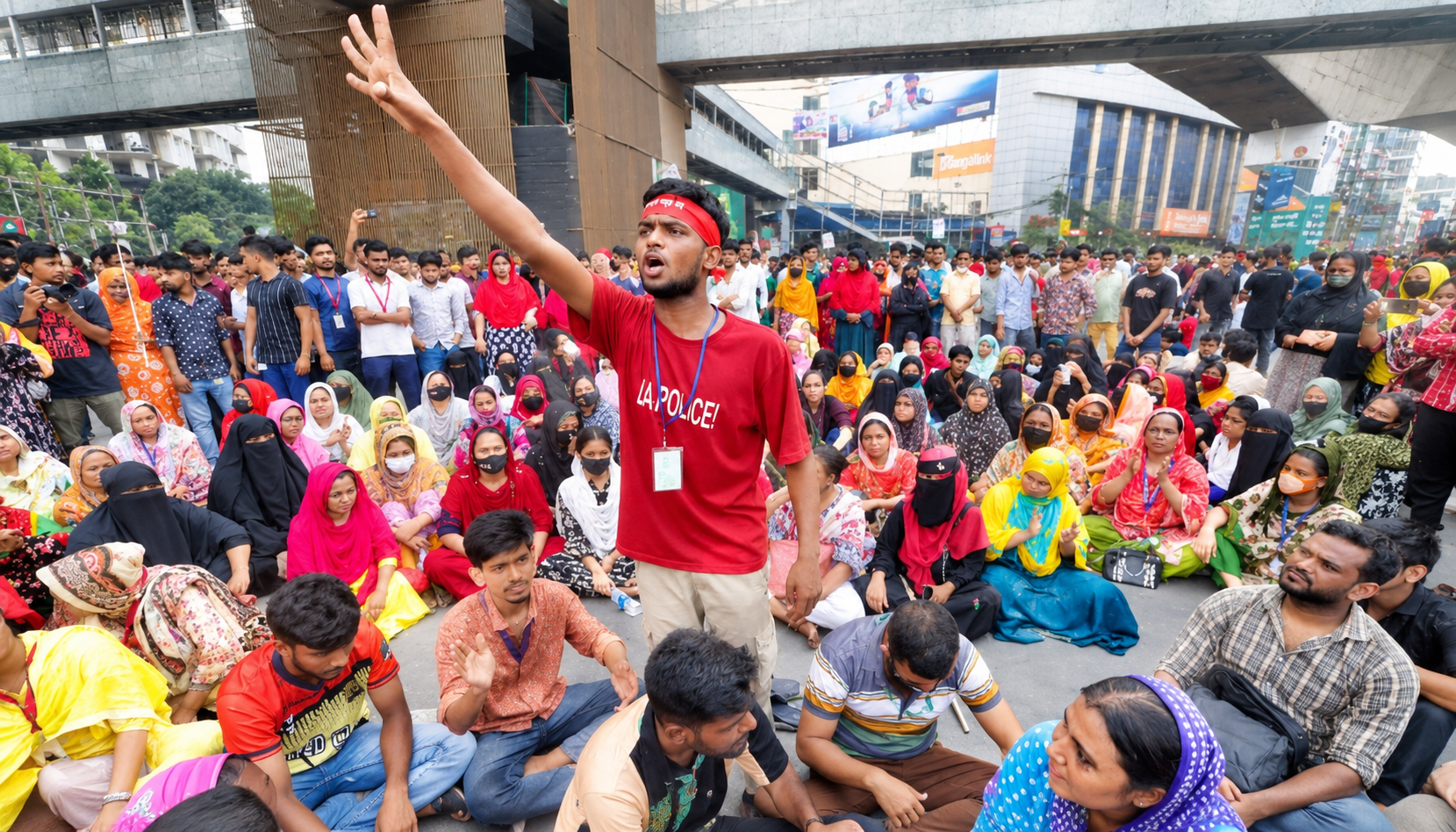
Bangladesh’s ready-made garment (RMG) sector has been hit by widespread labour unrest, forcing 529 factories to suspend production on Sunday, 1 November. Workers demanding a minimum monthly wage of Tk 30,000 staged protests, blocked major highways, and clashed with police, raising serious concerns among factory owners about the country's export prospects.
The unrest comes at a critical time for the garment industry, as October to February or March is considered the peak season for international buyers to place orders for the upcoming summer season. Industry representatives fear that prolonged disruption could damage Bangladesh’s reputation as a reliable sourcing destination and push international buyers towards competing countries.
Protests Spread Across Major Industrial Zones
The demonstrations, which initially began on a limited scale in Uttara and Mirpur, gradually spread to Ashulia, Savar, Gazipur and other industrial areas.
On Sunday morning, garment workers gathered at the Mirpur-10 roundabout and blocked the roads, bringing traffic to a standstill. Clashes erupted when police attempted to clear the blockade. During the confrontation, a police vehicle was set on fire beneath the Mirpur-11 metro rail station.
Police used tear gas, sound grenades and water cannons to disperse the protesters. Several workers and police personnel were reportedly injured. According to the Deputy Commissioner of Mirpur Division, 19 people had been detained by 8pm.
Violence was also reported in Gazipur and Savar. Workers blocked the Dhaka-Tangail and Dhaka-Aricha highways, disrupting local and long-distance transportation. Incidents of arson and vandalism were reported at several locations, including factory warehouses, police facilities and vehicles.
More than 50 factories in Ashulia reportedly declared holidays amid the deteriorating situation. Border Guard Bangladesh (BGB) personnel were deployed in several industrial areas of Gazipur to maintain law and order.
Government Forms New Wage Board
In response to the growing unrest, the Ministry of Labour and Employment has formed a six-member wage board to review garment workers' wages.
Labour and Employment Minister Ariful Haque Chowdhury urged workers to return to their workplaces following the formation of the board. However, the announcement failed to immediately restore normal production.
Prime Minister Tarique Rahman also convened an emergency meeting with the Home Minister, Labour Minister, labour adviser and other senior government officials.
At the meeting, the Prime Minister instructed the relevant authorities to remain vigilant to ensure the uninterrupted operation of factories and industries and protect public safety and property.
Home Minister Salahuddin Ahmed is expected to meet factory owners to discuss the situation.
Exporters Fear Losing International Buyers
The timing of the unrest has created particular concern among garment exporters. Following the relatively slow business period in August and September, international buyers are preparing to negotiate and place orders for the next summer season.
According to BGMEA sources, workers at 529 factories left their workplaces without commencing production on Sunday. More than one million workers are employed in these factories.
Factory owners fear that repeated disruptions, vandalism and security concerns could undermine international buyers' confidence in Bangladesh.
A senior factory official told The Business Standard that a delegation of European buyers visiting a leading garment factory had remained stranded inside the premises for an extended period due to the unrest.
Although the delegation eventually encountered no further difficulties, the incident reportedly left a negative impression of Bangladesh's industrial environment.
Fakir Kamruzzaman Nahid, Managing Director of Fakir Fashions, said that approximately 40% of the industry's annual export orders are secured between October and February or March.
He warned that instability during this crucial period could cause significant damage to Bangladesh's garment industry, particularly if buyers postpone or redirect their orders to other sourcing destinations.
Factory Owners Consider Temporary Closures
Amid continued disruption, garment factory owners have decided to invoke Section 13(1) of the Bangladesh Labour Act, 2006, to temporarily close factories if workers continue refusing to work despite the formation of the new wage board.
The decision was taken at a meeting held at the BGMEA office in Uttara on Sunday.
BGMEA President Mahmud Hasan Khan Babu said factory owners expected workers to return to production following the government's decision to establish the wage board.
He warned that keeping factories operational would become increasingly difficult if workers continued to refuse work or engage in vandalism.
Labour Leaders Criticise Delayed Wage Board Formation
Labour leaders have criticised the government for delaying the formation of the wage board, arguing that workers' representatives had been demanding it for nearly two months.
Tawhidur Rahman, former General Secretary of the IndustriALL Bangladesh Council, said that the government could potentially have avoided the current crisis by responding to workers' demands earlier.
However, he also expressed concern that groups with vested interests might have infiltrated the legitimate wage movement and contributed to the escalation of violence.
Some labour leaders have also raised allegations of political involvement in the unrest, although no detailed evidence has been publicly presented.
Economic Implications for Bangladesh
Bangladesh's garment industry contributes more than 80% of the country's total export earnings and remains one of the largest sources of employment, supporting approximately four million workers.
The sector generated around $38.70 billion in export earnings during FY2025-26.
The ongoing unrest therefore presents a significant challenge for the government, factory owners and labour representatives.
Ensuring fair wages and protecting workers' rights must go hand in hand with maintaining industrial security, uninterrupted production and international buyer confidence.
If the situation is not resolved quickly through meaningful dialogue and effective government intervention, Bangladesh could face substantial losses in export orders, employment opportunities and international market competitiveness.
The immediate priority is to restore industrial stability through cooperation among workers, employers and the government while ensuring that legitimate wage demands are addressed.
Comments
No comments yet. Be the first.
Related Stories
Related Stories

First published 2 November 2026. Spotted an error? Read our corrections policy.