
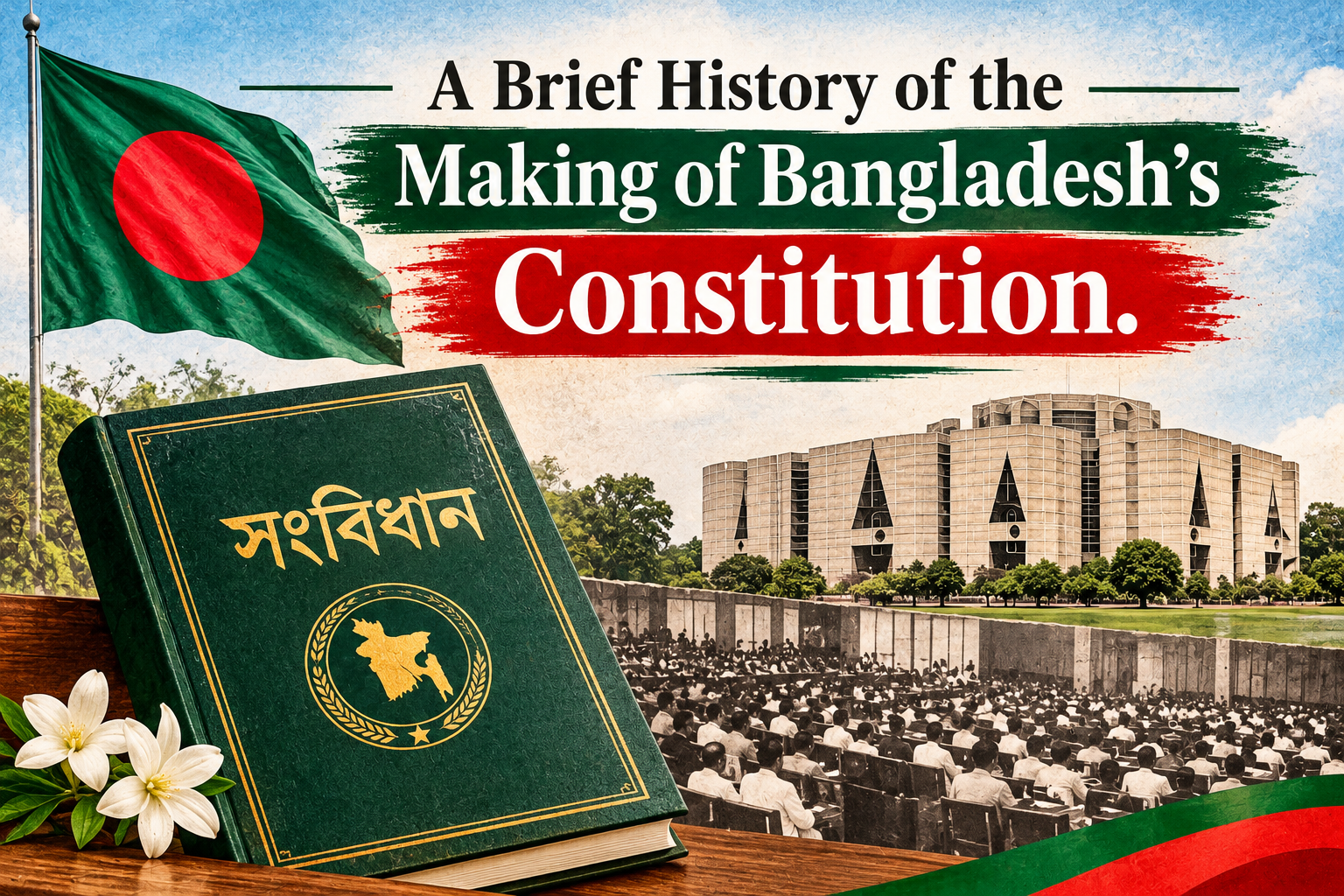
November 4, 1972, marks the birth of the Constitution of Bangladesh. To commemorate Constitution Day, it is worth revisiting the major historical developments that led to the creation of the country’s supreme law.
A constitution establishes the fundamental principles governing a state. It defines the structure of government, the responsibilities and powers of its institutions, and the limits within which those powers may be exercised. As the supreme law of the country, it overrides any ordinary law that contradicts its provisions. Constitutions may be written or unwritten, while their amendment procedures may be either rigid or flexible. Bangladesh has a written constitution with a relatively rigid amendment process.
The First Constitutional Framework: The Proclamation of Independence
The history of Bangladesh’s Constitution is closely connected to the country’s Liberation War.
Following the declaration of independence on March 26, 1971, the Provisional Government of Bangladesh issued the Proclamation of Independence (POI) on April 10, 1971. The proclamation served two important purposes. It explained the legal and political grounds for Bangladesh’s independence to the international community and established the institutional framework for administering the newly independent state.
It also defined the structure of the provisional government, its different organs and the powers entrusted to them. In effect, the proclamation provided the essential legal foundation for running the government during the Liberation War. For this reason, it is widely regarded as the first constitutional instrument of Bangladesh.
Significantly, the proclamation was given retrospective effect from March 26, 1971. This meant that Bangladesh had a constitutional framework from the very beginning of its independence.
From Presidential to Parliamentary Government
Almost a month after Bangladesh achieved victory in the Liberation War, the Provisional Constitution of Bangladesh Order, 1972, was adopted on January 11, 1972.
This order transformed the country's system of government from a presidential model to a parliamentary one. Although temporary in nature, it is regarded as the country's second constitutional instrument.
Subsequently, on March 23, 1972, the Constituent Assembly of Bangladesh Order, 1972, was promulgated. This measure established the legal basis for forming a Constituent Assembly and preparing a permanent Constitution.
Drafting and Adoption of the Constitution
The Constituent Assembly held its first session on April 10, 1972—exactly one year after the Proclamation of Independence had been issued.
The following day, on April 11, a 34-member Constitution Drafting Committee was established, with Dr Kamal Hossain serving as its chairman.
The committee prepared the draft Constitution Bill, which was presented before the Constituent Assembly on October 12, 1972. Its first reading began on October 19. Following the subsequent stages of deliberation and the third reading, the Constitution was finally adopted.
The Constitution came into effect on December 16, 1972, coinciding with the first anniversary of Bangladesh's victory in the Liberation War.
Compared with the constitution-making processes of countries such as India and Pakistan, Bangladesh completed the preparation and adoption of its Constitution within a remarkably short period.
A Constitution That Has Endured
The average lifespan of a written constitution is estimated to be around 19 years. Bangladesh’s Constitution, however, has remained in force for 54 years.
During this period, it has undergone 17 amendments. Despite these changes, its fundamental constitutional identity and underlying principles have continued to shape the country's legal and political framework.
The making of Bangladesh’s Constitution was not simply a legal exercise. It was an important part of the nation's transition from a liberation struggle to an independent state. The Proclamation of Independence, the temporary constitutional arrangements of 1972 and the work of the Constituent Assembly collectively laid the foundation for the constitutional order that governs Bangladesh today.
Comments
No comments yet. Be the first.
Related Stories
Related Stories
First published 4 November 2026. Spotted an error? Read our corrections policy.