
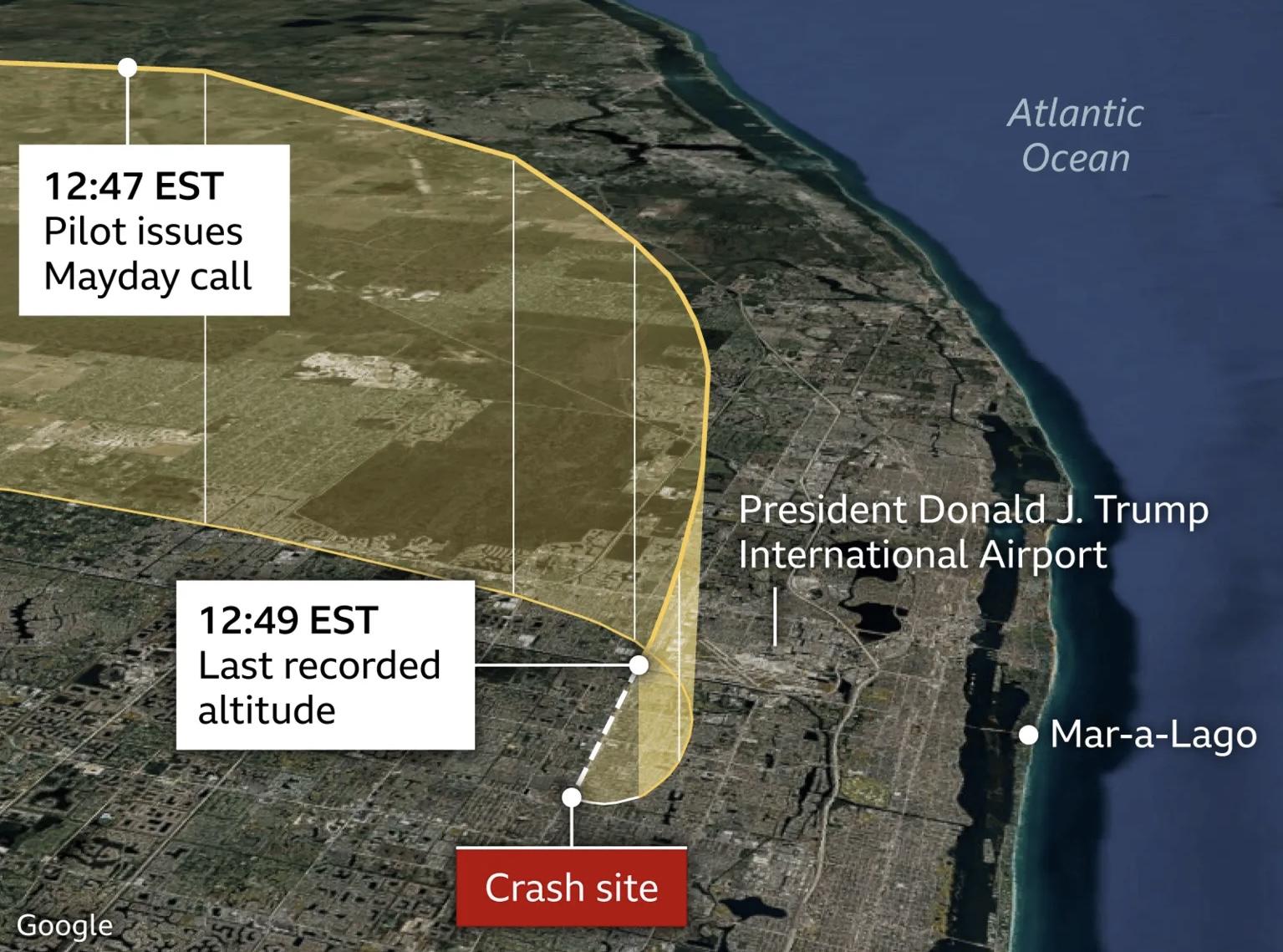
Investigators in the United States are examining whether a private jet began breaking apart in the air before crashing in Florida, killing all nine people aboard. Early evidence suggests the aircraft may have suffered structural damage during its rapid descent, but officials have not yet established what caused the disaster.
The Learjet 60 crashed on Sunday, November 1, in Palm Beach County, near Greenacres, Florida. It was travelling from Austin, Texas, to North Eleuthera in the Bahamas when it went down in a residential area. The National Transportation Safety Board (NTSB) is leading the investigation, with support from the Federal Aviation Administration (FAA).
At a news briefing on Monday, NTSB board member Tom Chapman said investigators had found indications that parts of the aircraft may have separated before the jet struck the ground. He explained that additional pieces of wreckage could be found away from the main crash site as investigators continue examining the surrounding area.
The finding has raised important questions about the aircraft’s final moments. Investigators are working to establish whether the jet experienced a mechanical problem, encountered dangerous weather conditions or suffered a combination of factors that led to the crash. No official cause has been determined, and the early evidence remains subject to further examination.
A sudden and dangerous descent
Communications between the flight crew and air traffic controllers are among the most important pieces of evidence available to investigators. According to information released by the NTSB, the crew reported ice and moderate turbulence while the aircraft was flying at approximately 35,000 feet.
The pilots were attempting to find more favourable flying conditions when the situation became increasingly serious. The aircraft began losing altitude rapidly, prompting the crew to declare an emergency and alert air traffic control.
Information from the final communications indicated that the descent was accelerating at an alarming rate. The reported vertical speed reached approximately 22,000 feet per minute, while flight tracking data suggested that it briefly exceeded 32,000 feet per minute before the signal ended.
These figures have become a major part of the investigation because they indicate how quickly the aircraft lost altitude. Investigators will compare the flight tracking information with air traffic control recordings, weather data and physical evidence from the wreckage to reconstruct the sequence of events.
The crew’s reports of ice and turbulence have also drawn attention to the weather conditions at the time. Ice can affect an aircraft’s aerodynamic performance under certain circumstances, while severe turbulence can place significant forces on an aircraft. However, neither factor has been confirmed as the cause of this crash.
Investigators will need to determine the type and severity of the weather encountered by the jet, whether ice accumulated on its surfaces and whether any such conditions contributed to the rapid loss of altitude.
Crash leaves extensive damage
The aircraft struck the ground near a road in Palm Beach County and exploded, creating a large crater and scattering debris across the surrounding area. Emergency crews arrived at the scene as authorities moved to secure the location and assist affected residents.
The impact caused significant disruption in the nearby community. Around 600 residents from a mobile home area were evacuated or displaced while emergency services and investigators worked at the site. Authorities arranged temporary shelter for people unable to return to their homes during the initial response.
The wreckage recovery process has presented additional challenges. Heavy rain left water inside the crater created by the impact, making it harder for investigators to access and examine the remains of the aircraft.
Officials are documenting the debris and identifying individual components to establish whether any parts separated before the jet hit the ground. The location of the wreckage may help investigators determine how the aircraft behaved during its final descent.
One person on the ground was also reported to have suffered a leg injury. Authorities have not indicated that anyone else on the ground was seriously injured.
Nine people killed
All nine people aboard the aircraft died in the crash. Among the victims were technology entrepreneur Adam Robinson, his wife, Helen Sharp, their two young children, Emma and Charlie, family caretaker Anita Maria Cetina, and their friends Rachael Reed and Charmi Fehr. The two pilots were also killed.
The deaths have brought attention to the families and communities affected by the disaster. Robinson was known for his work in the technology sector, while the presence of two young children among the victims has added to the tragedy surrounding the crash.
One of the pilots was identified as Nathalia Gadelha Filgueiras, a 20-year-old copilot who obtained her pilot’s licence at the age of 17 through an aviation programme. Reports about her final communications with air traffic control have highlighted the difficult circumstances faced by the flight crew as the emergency unfolded.
The aircraft was operated as a private jet, and its journey had been expected to take the passengers from Texas to the Bahamas. Instead, the flight ended in a disaster that has prompted a detailed federal investigation.
Investigators examine aircraft and weather records
The NTSB is expected to examine several areas as it works to determine the cause of the crash. These include the aircraft’s maintenance history, its mechanical systems, weather conditions along the flight path and the actions taken by the crew during the emergency.
Investigators are also trying to establish whether a cockpit voice recorder was aboard the aircraft when it crashed. Maintenance records indicate that one had been installed, but officials have said they still need to confirm whether it remained on the jet and can be recovered.
If the recorder is found and its data can be retrieved, it may provide further information about the crew’s conversations and the problems they encountered before impact. That evidence could be compared with air traffic control recordings and flight tracking data to create a clearer timeline.
The investigation will also examine the aircraft’s structure and the distribution of debris. If investigators can establish that parts separated in the air, they will seek to identify which components were involved and when the damage occurred.
Weather remains another major area of concern. Heavy rain and thunderstorms were reported in the region around the time of the crash. Investigators will assess whether the aircraft encountered a particularly dangerous combination of icing, turbulence and storm activity.
However, experts caution that the presence of severe weather does not automatically explain an aircraft accident. A reliable conclusion requires evidence showing how the conditions affected the specific aircraft and whether other technical or operational factors contributed.
A final answer may take time
The investigation is expected to continue as specialists examine the wreckage and analyse the available records. Recovering evidence from a heavily damaged aircraft can be complicated, particularly when debris is scattered over a wide area and weather interferes with work at the scene.
The NTSB has emphasised that determining the cause of an accident requires more than reconstructing its final moments. Investigators must establish why the events occurred and whether changes in aircraft maintenance, operating procedures, training or safety practices could help prevent similar incidents.
For now, the evidence points to a rapid descent, reports of ice and turbulence, and the possibility that the aircraft began breaking apart before impact. The relationship between these events remains unclear.
The investigation’s findings will be closely watched by aviation authorities and the wider industry. Until investigators complete their work, the exact cause of the Florida crash remains unknown.
Comments
No comments yet. Be the first.
Related Stories
Related Stories
First published 3 November 2026. Spotted an error? Read our corrections policy.