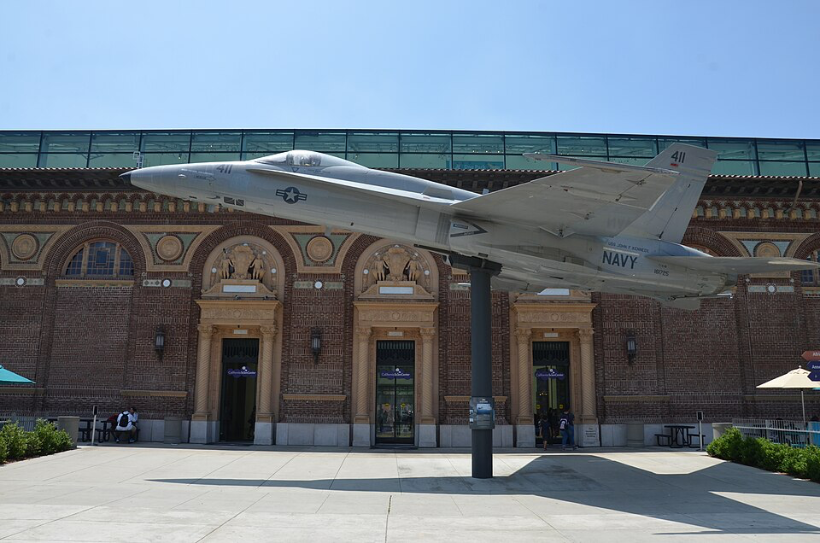
The California Science Center in Los Angeles is preparing to open an ambitious new exhibition that promises to bring the history, science and excitement of aviation and space exploration closer to the public. The new facility, named the Samuel Oschin Air and Space Center, will welcome visitors on November 13, offering an opportunity to explore decades of scientific achievements through historic spacecraft, educational displays and hands-on experiences.
Located in Exposition Park, the new center represents a major expansion of the existing California Science Center. Covering approximately 200,000 square feet, the addition is designed to introduce visitors to the technologies, discoveries and engineering developments that have helped shape human exploration beyond Earth.
The project is the result of a collaboration spanning several decades between the California Science Center and NASA's Jet Propulsion Laboratory (JPL). Through this partnership, the exhibition aims to connect the public with the scientific work behind aviation, space missions and planetary research. Rather than simply displaying historical objects, the center intends to help visitors understand how these achievements were made and why they continue to influence modern science.
One of the biggest attractions will be the Space Shuttle Endeavour, which will take center stage inside the new facility. The spacecraft will be displayed in a vertical launch configuration, accompanied by its external fuel tank and two solid rocket boosters. This arrangement will allow visitors to see the complete shuttle system in a way that closely resembles its position before a launch.
Endeavour holds an important place in American space exploration. It was the final space shuttle constructed under NASA's shuttle programme and completed 25 missions during its operational career. Its journeys contributed to major scientific and technological efforts, including work connected to the International Space Station and the Hubble Space Telescope.
The shuttle's new display is expected to become a major educational attraction, allowing visitors to appreciate the enormous scale and complexity of a spacecraft designed to travel beyond Earth's atmosphere. It will also provide an opportunity to learn about the people, research and engineering work that made such missions possible.
The exhibition will be divided into three main galleries, each focusing on a different aspect of aerospace development. Together, they will provide visitors with an opportunity to explore the relationship between aviation, space technology and scientific discovery.
The Korean Air Aviation Gallery will introduce visitors to the science of flight. Among its major attractions will be a Boeing 747 aircraft operated by Korean Air. Part of the aircraft's passenger cabin and internal structure will be exposed, giving visitors a closer look at how commercial planes are designed and constructed. The gallery will also feature different types of aircraft and an interactive drone activity. Through this experience, visitors will be able to simulate the delivery of medical supplies across a model of Los Angeles.
The Kent Kresa Space Gallery will focus on humanity's efforts to understand and explore the universe. It will feature rockets, robotic spacecraft, astronaut capsules and telescopes. Visitors will also have the opportunity to walk through a section of a solid rocket booster, operate a miniature Mars rover through a programming activity and explore a replica of the International Space Station.
These interactive activities are expected to make complicated scientific ideas easier to understand, particularly for younger visitors. Instead of learning only through written explanations, children and adults will be able to experience different aspects of aerospace engineering through practical activities.
The third section, known as the Samuel Oschin Shuttle Gallery, will house Endeavour and its launch equipment. The vertical arrangement of the spacecraft is one of the most ambitious elements of the entire project. The idea of presenting the shuttle in this position was first considered in 1992. Its eventual installation will allow visitors to see the orbiter, external tank and rocket boosters together as a complete launch system.
According to David Barnhart, a research professor of astronautical engineering and director of the University of Southern California's Space Engineering Research Center, the enormous scale of the installation will be one of its most striking features. Seeing the spacecraft from below is expected to give visitors a better appreciation of the engineering challenges involved in launching humans and equipment into orbit.
The expansion will also significantly increase the museum's educational resources. It will nearly double the Science Center's exhibition space and introduce around 100 interactive exhibits alongside approximately 100 historical artifacts. The displays have been developed to make scientific knowledge accessible to people without an advanced background in science or engineering.
Education is another major focus of the new facility. The California Science Center hopes to encourage young people to consider careers in science, technology, engineering and mathematics, commonly known as STEM. Its location in South Central Los Angeles also makes it an important educational resource for nearby schools and communities.
The museum has already supported students through internship programmes, including opportunities for high school students interested in science and technology. Some of these positions have also been paid, helping students gain practical experience while exploring possible career paths.
The collaboration with the University of Southern California has contributed to the development of some of the new interactive experiences. USC students have helped create a multiplayer activity in which visitors must work together to plan a mission to Mars or the Moon. The activity is designed to demonstrate how teamwork, problem-solving and scientific knowledge are essential to successful space missions.
The exhibition also reflects the importance of preserving earlier scientific achievements. Although space technology continues to develop, historical spacecraft and equipment provide valuable information about how engineering has changed over the years. They allow researchers and visitors to examine earlier designs, understand past challenges and recognise the discoveries that helped make modern space exploration possible.
Barnhart has highlighted the importance of connecting historical achievements with present-day scientific progress. For younger generations, seeing these objects in person can make the history of space exploration more meaningful and encourage curiosity about what humanity might achieve in the future.
The new center is also expected to strengthen Los Angeles' position as an important destination for science education and cultural activities. By bringing together aviation history, space technology and interactive learning, the facility aims to attract families, students, researchers and science enthusiasts.
The Samuel Oschin Air and Space Center will officially open to the public on November 13. Although general admission to the exhibition is free, visitors will need to pay a $4 service fee per ticket. With its historic spacecraft, educational programmes and interactive displays, the new facility is expected to offer visitors a closer look at the achievements that have shaped humanity's journey into space.
Comments
No comments yet. Be the first.
Related Stories
Related Stories
First published 6 November 2026. Spotted an error? Read our corrections policy.