
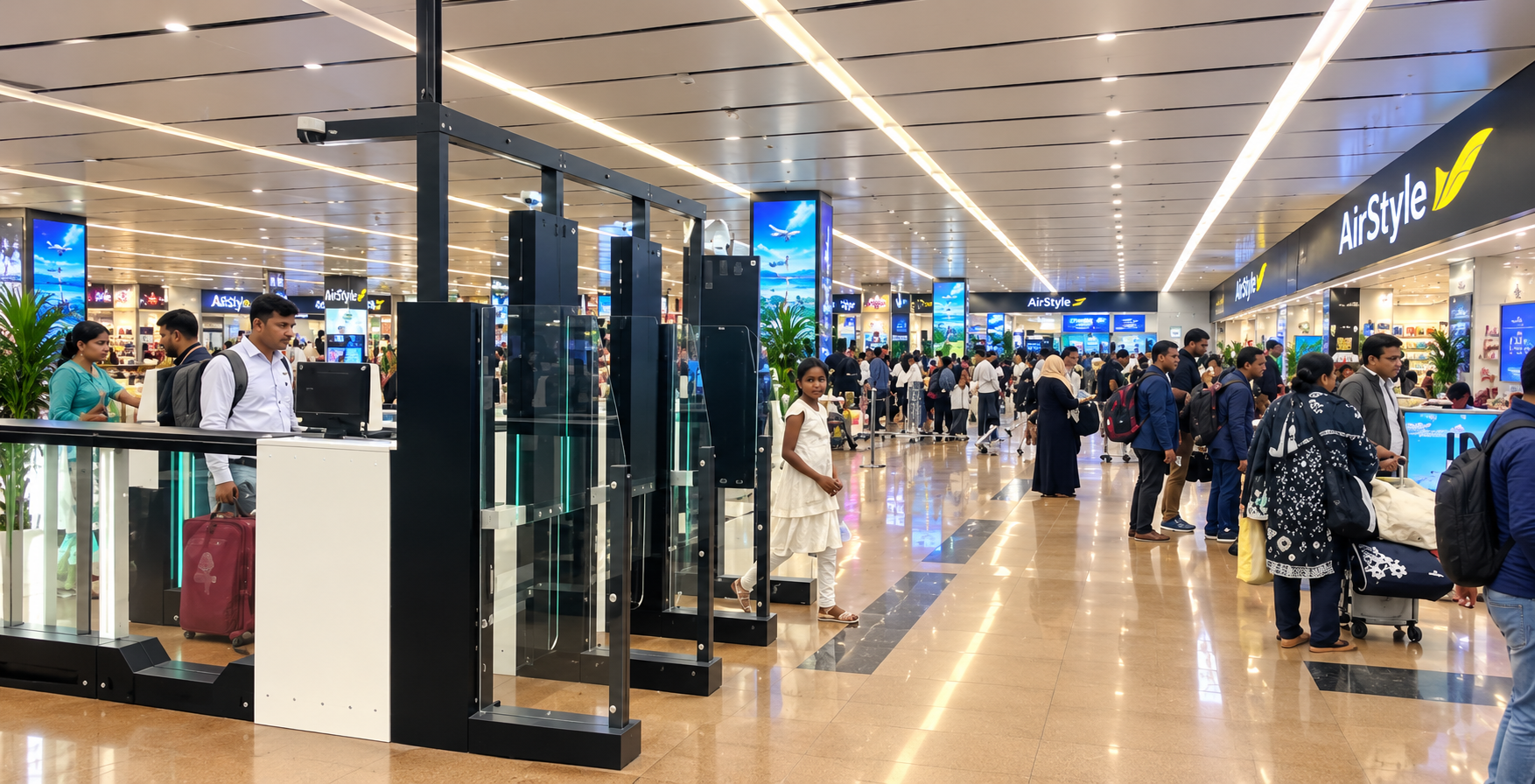
The new automated system allows e-passport holders to complete immigration procedures in just 18 to 20 seconds. However, authorities are still working to modernise departure immigration services.
Bangladesh has taken another step towards digitising its airport immigration services. An automated immigration system, commonly known as e-gates, has been introduced at the arrival section of Hazrat Shahjalal International Airport in the capital.
Under the new system, passengers holding electronic passports, or e-passports, can complete immigration procedures in just 18 to 20 seconds. This is expected to reduce long waiting times while easing congestion and pressure at the airport.
According to immigration officials, the service has brought positive changes to the arrival experience of international passengers. However, automated immigration at the departure section remains suspended due to several technical and operational limitations.
In an interview with Dhaka Tribune on Monday, Major General Md Alimul Amin, Director General of the Department of Immigration and Passports (DIP), confirmed the introduction of e-gate services at the airport's arrival section.
He said the authorities were also working to introduce the facility at departure counters. However, the system has yet to develop the technical capacity required to complete all necessary procedures.
Although departing passengers' passports can be scanned through the e-gates, the system cannot currently complete the required stamping process. As a result, the service cannot yet be fully implemented at the departure section.
Manual Arrival Stickers Still Required
Despite the introduction of automated immigration, some procedures are still being carried out through the conventional system.
During a recent visit to the airport, a Dhaka Tribune correspondent observed that arriving passengers were still required to collect immigration stickers separately from a police booth even after completing the immigration process through the e-gates.
Airport authorities expect this additional step to be eliminated once the airport's third terminal becomes operational. Under the proposed system, passengers will no longer need to visit a separate police booth to collect arrival stickers.
Technical Challenges Delay Automation of Departure Immigration
Airport immigration authorities are facing several obstacles in their efforts to introduce a fully digital system. These challenges are particularly evident in the case of departing passengers.
The major problems include an insufficient number of e-gates, shortages of barcode and biometric scanning devices, frequent server connectivity disruptions and slow information technology systems.
Another significant challenge is the lack of real-time data-sharing coordination among the National Identity Card (NID) database, the Department of Immigration and Passports, and the Bureau of Manpower, Employment and Training (BMET).
As a result, even minor discrepancies in passengers' names or dates of birth can sometimes prevent the automated system from accurately verifying their identities.
In addition, technical errors in facial recognition cameras and fingerprint verification systems occasionally prevent legitimate passengers from gaining access through the automated gates.
It has also been reported that some immigration personnel lack adequate technical training to operate digital infrastructure and verify electronic visas.
Major General Alimul Amin acknowledged that several institutional, technical and practical challenges must be addressed before departure immigration can become fully automated.
He said the authorities were working quickly to simplify immigration procedures and improve the quality of passport-related services.
Passengers Welcome Faster Immigration Services
The introduction of e-gates at the airport's arrival section has received a positive response from international passengers. In particular, e-passport holders have expressed satisfaction with the service.
According to passengers, the automated system has significantly reduced waiting times and made the process of returning home from abroad much easier.
Litton Kabir, who recently returned home from Thailand, welcomed the initiative to reintroduce the service. He recalled that the introduction of e-passports for Bangladeshi citizens had once been an important expectation. At the time, it was hoped that e-gates would make international travel easier.
He expressed hope that automated immigration would soon be introduced at departure counters as well.
Rajib Ahmed, who returned home after travelling to Turkey with his family, also praised the new system. He said being able to complete immigration in just 18 seconds was a great relief for passengers.
He added that introducing the same facility at the departure section would save passengers a considerable amount of time. He urged the government to prioritise the initiative.
However, an immigration official said that although e-gates had previously been introduced at the departure section, passengers still had to return to conventional immigration counters for visa verification and other formalities. This had created additional inconvenience rather than reducing it.
The official said information collected through the automated gates was not always transferred properly to the immigration software. These problems eventually led to the decision to suspend e-gate operations at the departure section.
Currently, e-gates are operational at the arrival section of Hazrat Shahjalal International Airport, but the facility is not available for departing passengers.
Why Were Departure E-Gates Suspended?
In February 2020, Bangladesh launched its e-passport programme, becoming the first country in South Asia to introduce the system.
Following the introduction of electronic passports, automated immigration gates were installed at Hazrat Shahjalal International Airport to speed up passenger clearance and modernise border management.
However, from the beginning, the technology could not completely eliminate the need for conventional manual immigration checks.
Several members of the Special Branch (SB) immigration police, speaking on condition of anonymity, said that approximately 40 per cent of the airport's daily passengers use e-passports.
Although the automated gates can verify passport information and passenger identities, the system does not have the capability to independently verify visa information.
Moreover, it lacks adequate facilities for automatically recording passengers' destinations and flight-related information.
As a result, even after scanning their passports through the automated gates, passengers must still undergo manual visa verification and complete other formalities.
Having to complete the same process twice increases pressure on departure immigration counters. The inconvenience becomes even greater when several international flights operate within a short period.
Executive Director of Hazrat Shahjalal International Airport, Group Captain SM Ragib Samad, confirmed the matter, saying that the existing e-gate infrastructure can verify passport information but lacks the capacity to independently process visa-related information and other necessary details.
He said this was why e-gate services at the departure section remained temporarily suspended. However, the authorities hoped to resume the service in the near future.
Government Initiatives to Modernise Immigration Infrastructure
Meanwhile, the government has undertaken a broader programme to modernise Bangladesh's immigration management system by integrating advanced digital technologies with existing infrastructure.
As part of the initiative, the Ministry of Home Affairs has formed a 10-member committee to review the financial and operational framework required to develop the Immigration Management System (IMS).
The ministry's Security Services Division issued a related notification on October 19, which was published on October 25.
Under the proposed modernisation programme, several digital platforms are expected to be integrated with the existing immigration infrastructure.
These include:
Advance Passenger Information System (APIS): Facilitating the electronic collection and exchange of passenger information before their arrival.
Passenger Name Record (PNR): Improving the management of passengers' booking and travel-related information.
Electronic Visa (e-Visa): Simplifying the visa verification process through digital technology.
Electronic Travel Authorisation (ETA): Making the travel authorisation process easier and faster.
Sovereign Data Analytics Platform: Strengthening national-level data management and analytical capabilities.
The government is also considering engaging a third-party organisation to support infrastructure development and the implementation of the modernisation programme.
The 10-member committee will review immigration service fees, revenue collection methods, financial transactions and payment procedures. It will also make recommendations on appropriate service charges and the development of a sustainable financial framework.
The Joint Secretary of the Planning-1 Wing of the Ministry of Home Affairs has been appointed as the committee's chairperson, while the Deputy Secretary of the Exit-4 Wing will serve as its member-secretary.
Representatives from the Finance Division, National Board of Revenue (NBR), Civil Aviation Authority of Bangladesh (CAAB), Special Branch, Biman Bangladesh Airlines, Bangladesh Land Port Authority and the Department of Immigration and Passports have also been included in the committee.
Bangladesh Moves Towards a More Efficient Immigration System
The introduction of e-gates at the airport's arrival section marks an important step forward in modernising Bangladesh's international travel procedures.
However, to fully benefit from digital immigration services, the country must address existing technical limitations, improve coordination among different institutions, ensure effective integration of relevant databases and provide adequate technical training to immigration personnel.
If the proposed modernisation programme is successfully implemented, manual procedures will be reduced, passenger inconvenience will decline, border management will become stronger, and international travel through Bangladeshi airports will become easier and more efficient.
For now, arriving passengers are already benefiting from the automated immigration system. The biggest challenge facing the authorities is to ensure the same level of speed and convenience for departing passengers.
Comments
No comments yet. Be the first.
Related Stories
Related Stories

First published 3 November 2026. Spotted an error? Read our corrections policy.