
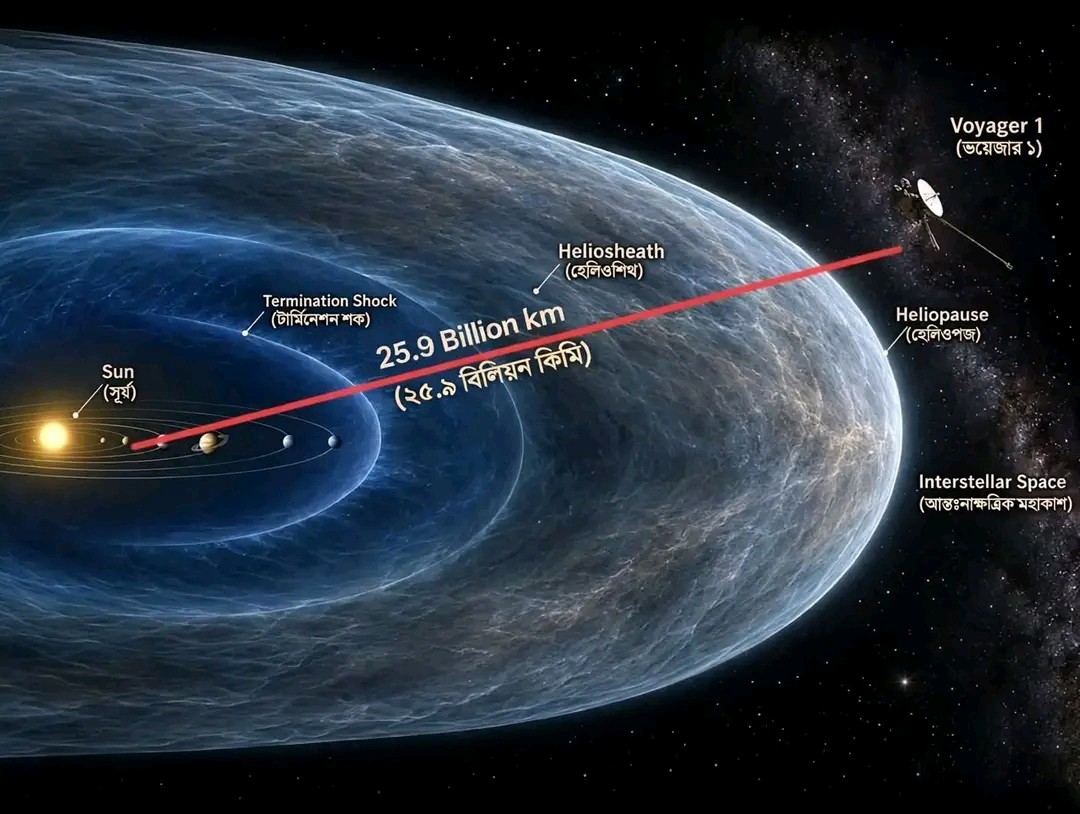
Launched on September 5, 1977, NASA’s Voyager 1 spacecraft has etched its name in history as the most distant human-made object in existence. Originally designed for a primary mission to explore Jupiter and Saturn, this remarkable piece of engineering has far exceeded its initial objectives, venturing deeper into the cosmos than any spacecraft before it. Today, Voyager 1 operates in the mysterious realm of interstellar space, serving as our silent ambassador to the stars and capturing the imagination of humanity across generations. A Historic Mission and Grand Tour The Voyager program was originally conceived to take advantage of a rare planetary alignment that occurs only once every 176 years. This alignment allowed a single spacecraft to use gravity assists from Jupiter and Saturn to slingshot further into the outer solar system, later expanding to include Uranus and Neptune via Voyager 2. Voyager 1 made its closest approach to Jupiter in March 1979, sending back stunning, high-resolution images of the gas giant's turbulent atmosphere, the Great Red Spot, and its complex moon system. By November 1980, the spacecraft reached Saturn, revealing intricate details of its iconic ring system and discovering new moons, including the nitrogen-rich atmosphere of Titan. Following its Saturn flyby, Voyager 1 deviated from the planetary plane to head north relative to the ecliptic plane, embarking on an epic journey toward the edge of the solar system. Crossing the Threshold into Interstellar Space One of the most monumental milestones in space exploration occurred in August 2012, when Voyager 1 officially crossed the heliopause—the boundary where the sun's constant flow of material and magnetic field stops dominating the surrounding space. By stepping out of the heliosphere and entering the interstellar medium, Voyager 1 became the first human-made object to touch the space between the stars. As of today, the spacecraft is located more than 24 billion kilometers (nearly 15 billion miles) away from Earth. To put this immense distance into perspective, radio signals traveling at the speed of light take over 22 hours just to reach Voyager 1, meaning a round-trip communication takes nearly a full day. Despite being billions of miles away from our sun, the spacecraft continues to measure interstellar plasma, magnetic fields, and cosmic rays using its surviving scientific instruments. The Challenges of Aging Technology Operating for nearly five decades in the harsh, freezing environment of deep space comes with profound technical hurdles. Voyager 1 is powered by three Radioisotope Thermoelectric Generators (RTGs), which convert the heat from the natural radioactive decay of plutonium-238 into electricity. As this radioactive fuel gradually decays, the spacecraft's power output steadily declines year by year. To conserve energy, mission controllers at NASA’s Jet Propulsion Laboratory (JPL) have systematically turned off non-essential instruments, heaters, and systems over the decades. In recent years, the spacecraft has experienced computer glitches due to aging memory chips and hardware, yet ingenious engineering teams on Earth have continuously devised remote software patches and workarounds to keep the mission alive. A Message in a Bottle Beyond its scientific instruments, Voyager 1 carries a cultural time capsule designed to communicate the story of our world to any potential extraterrestrial intelligence it might encounter millions of years from now. Attached to the side of the spacecraft is the Golden Record—a 12-inch gold-plated copper phonograph record containing sounds and images selected to portray the diversity of life and culture on Earth. It includes spoken greetings in 55 languages, musical selections ranging from Bach and Beethoven to traditional global folk songs, natural sounds of wind, rain, and animals, and 115 analog images depicting human anatomy, landscapes, and civilization. A Lasting Legacy Voyager 1 stands as a monumental testament to human curiosity, perseverance, and ingenuity. Long after its power finally fades and its instruments go dark—projected to happen sometime in the 2030s—the spacecraft will continue its silent, eternal orbit around the center of the Milky Way galaxy. It will outlive human civilization on Earth as a floating monument to an era when a young species on a pale blue dot first reached out toward the stars.
Comments
No comments yet. Be the first.
Related Stories
Related Stories

First published 3 November 2026. Spotted an error? Read our corrections policy.