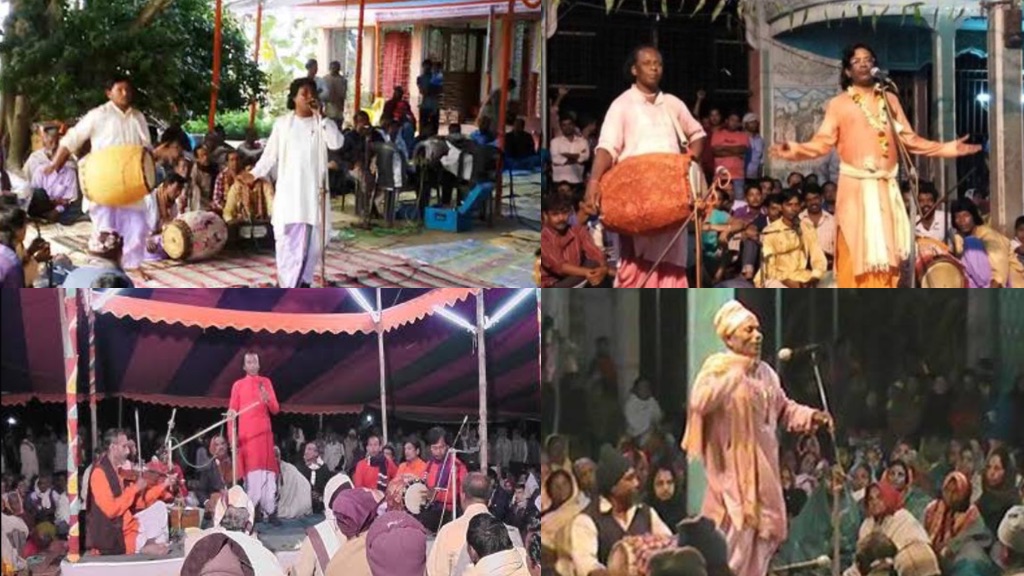
There was a time in Bengal when a village square could turn into a battlefield. No swords, no shouting, no violence. Just two poets standing before a crowd, armed only with their voices. This was Kobigaan, the poet song.
It began quietly in the early 1700s, growing out of older traditions like Baul music and Kirtan, both known for their soulful, spiritual songs. Slowly it grew into something bigger. By the late 1700s it had taken proper shape, with structure and rhythm and rules of its own. It found a home not just in villages but in the grand courtyards of landlords in Kolkata, Howrah, Burdwan and beyond. There, rich and poor sat together and watched the same show, laughed at the same jokes, felt the same thrill.
Picture the scene. Two poets, called kavials, standing face to face. Behind each one, a small group of singers ready to echo their lines. Drums beating steadily in the background. The night stretching on for hours, sometimes until dawn. The poets did not recite memorized verses. They created on the spot, pulling from mythology, love, politics, gossip, whatever the moment demanded. One would throw a challenge in verse. The other would answer instantly, sharper, funnier, wiser. The crowd was not silent. They laughed, they gasped, they took sides. It was theatre and poetry and sport all at once.
Some of these poets became legends in their own lifetime. Haru Thakur, whose duels drew crowds like today's biggest concerts. Bhola Moira, born poor, who spoke boldly against the powerful and never softened his tone for anyone. Ram Basu, whose songs of separation could make strangers weep. Anthony Firingee, a man of foreign blood who fell so deeply in love with the Bengali language that he became one of its finest voices. These men were not just performers. They were the conscience of their communities, saying out loud what others were too afraid to say.
But nothing stays forever. As cinema and radio arrived, then television, people slowly stopped gathering for long nights of live poetry. Villages emptied as people moved to cities looking for work. The landlords who once paid for these grand duels lost their power and their money. And because Kobigaan lived only in memory, spoken and never written down, so much of it disappeared the moment its poets died. By the 1980s, the art form that once filled entire fields with listeners had almost gone silent.
Yet something of it still breathes. In small pockets of rural Bengal, old singers still perform during festivals, keeping a fading flame alive. A few recordings sit carefully preserved in archives. Researchers and theatre artists occasionally bring pieces of it back to life on stage. It has not vanished completely. It waits.
There is something deeply moving about a tradition built entirely on the courage to speak. No weapons, no wealth, just a voice and the nerve to use it. In an age where so much of our expression happens through screens, Kobigaan reminds us of a simpler truth. That people once gathered under open skies just to listen, to feel, to be moved by another human being thinking out loud in verse. Perhaps that is why it deserves to be remembered, not as an old relic gathering dust, but as proof that words, spoken with courage and heart, can still bring people together long after the poets themselves are gone.
Comments
No comments yet. Be the first.
Related Stories
Related Stories
First published 28 September 2026. Spotted an error? Read our corrections policy.